

MagiFloater

Why Does RobustMotion's SoftForce® Earn the Name "Precision Force Control"?
Published:
2025-11-22
Keywords: SoftForce®Precision Force Control,Current-Loop Open-Loop Force Control, RM-NPLA-HF,IPEX Connector Assembly,3C Precision Assembly,Closed-Loop Force Control,Force Overshoot Suppression
Abstract: This article explains how SoftForce® ®Precision Force Control fundamentally differs from conventional current-loop force control: powered by proprietary model predictive control algorithms and microsecond-level processing frequency, it achieves closed-loop force accuracy up to ±0.01 N—shattering the industry trade-off between speed and precision. With real-time disturbance prediction and payload compensation, it stably outputs a 1 N micro-force while carrying a 3 kg payload, enabling high-speed, impact-free compliant contact. Four signature applications are highlighted: gripping burnt mosquito-coil ash (extreme micro-force), smartphone IPEX connector press-fitting (first-ever automation breakthrough), VR headset FPC hot-bar bonding (heavy-payload micro-pressure control), and 100% inline elastic modulus inspection of micro die-cut parts—automating the toughest final 10% of 3C and semiconductor processes previously reliant on manual dexterity.
In the automation industry, practically any device whose power source is electrical supply ,could conceivably claim to have ”force-control ”capability, 。because indeed, ,the vast majority of actuator products advertising "force control" actually refer to conventional current-loop open-loop force control.RobustMotion specifically emphasizes "SoftForce® ®Precision Force Control" because its fully in-house closed-loop force control technology delivers a far more accurate, streamlined, and intelligent solution.
Open-Loop Force Control vs. Assembled External-Sensor Closed-Loop Force Control
- Open-Loop Force Control:Estimates force from motor current, resulting in poor accuracy (±5%–15%) and unstable output unsuitable for delicate workpieces.
- Traditional Closed-Loop Force Control:Bolting together an external force sensor improves static accuracy (±1%), but turns speed and accuracy into mutually exclusive trade-offs. Maintaining accuracy forces slower cycle times; raising speed triggers force overshoot and oscillation that still damage workpieces.
Neither approach can handle ultra-force-sensitive precision processes that previously relied exclusively on skilled human hands.
How Does SoftForce® Achieve It? The Core Lies in Algorithms and Frequency
RobustMotion's SoftForce® ®Precision Force Control builds its core technological moat on proprietary model predictive control (MPC) algorithms and ultra-high-speed processing frequency.This ultra-fast "response speed" brings three transformative breakthroughs:
- 0.1%-Class Ultra-High Accuracy:By predicting and compensating for disturbances in real time, we stabilize force control accuracy at ±0.1% FS or better—reaching up to ±0.01 N in force control accuracy. 。For a target output of 100 N, the actual output stays tightly 99.9N-100.01Nbetween 99.99 N and 100.01 N, with virtually zero error.
- Breaking the "Speed vs. Accuracy" Trade-Off:Because the response speed is sufficiently fast, force overshoot is suppressed at the exact instant of high-speed workpiece contact, achieving impact-free compliant contact at high speeds.
- Achieving "Micro-Force Control Under Heavy Payloads":Our algorithms actively cancel the gravitational and inertial effects of attached tooling in real time.Taking RM-NPLA-HF(our precision force-controlled series miniature platform-type electric rod actuator )as an example, ,even when the actuator carries a 3 kg vision system or additional tooling, ,the electric actuator's end-effector still stably delivers 1Na consistent 1 N micro level of force output.。
RMAxis "Precision Force Control" Delivers Superior Automation Solutions
Let's look at proven real-world applications:
- Gripping Burnt Mosquito-Coil Ash:An extreme demonstration of active compliance and micro-force control—any slight lapse in force accuracy or response speed turns fragile ash into powder.
- Smartphone IPEX Connector Press-Fitting:A classic "human-hand replacement" process. Because the connector pin is slightly larger than the mating receptacle in an interference fit, conventional position control crushes components—forcing even leading smartphone assembly lines to rely on manual labor previously.RobustMotion's Precision Force Control uses high-frequency compliant tactile searching to emulate human fingertip press-fitting, completing this once-unautomatable task in a 6-second cycle time—making us the first company in China to solve this challenge.
- VR/AR Headset FPC Hot-Bar Bonding:An exceptionally demanding process where the heated thermode weighs 3 kg yet requires a precise 1 kgf pressing force under high temperatures—putting heavy-payload micro-force control to the ultimate test.
- 100% Inline Elastic Modulus Inspection of Micro Die-Cut Parts:Traditionally limited to slow manual sampling, our solution applies an exact 2 N test force inline while measuring deflection, upgrading quality assurance from spot-checking to 100% automated inspection.
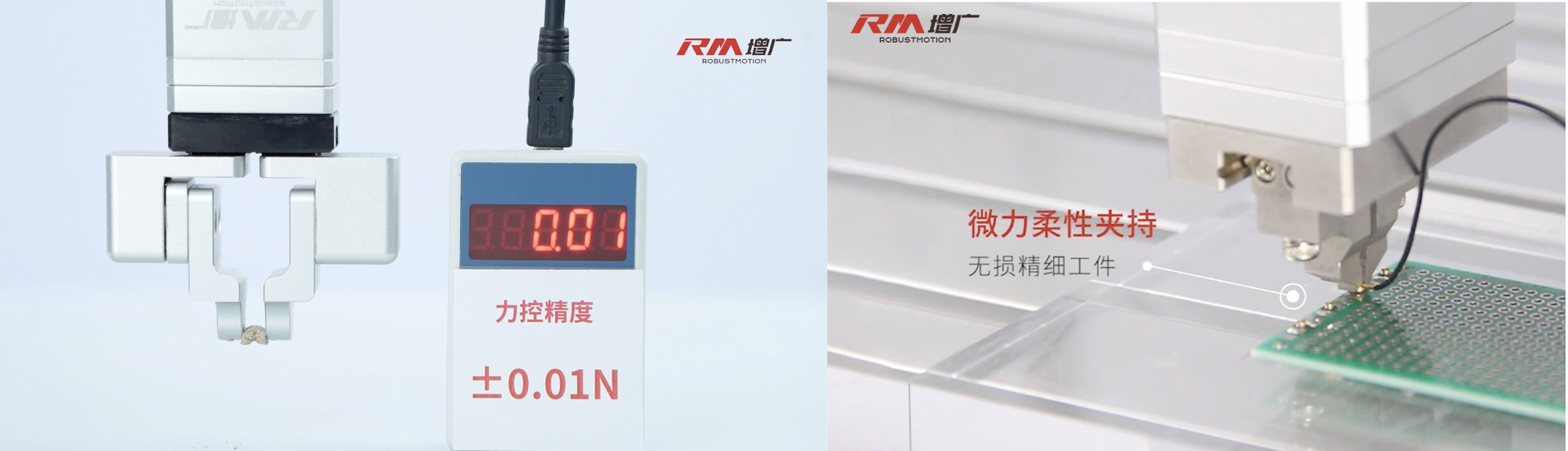
In summary, across 3C electronics and semiconductor manufacturing, standard actuators handle most routine automation steps, whereas RobustMotion's SoftForce® Precision Force-Controlled Actuators are purpose-built to conquer the remaining 10% of ultra-force-sensitive processes that previously required human hands and resisted automation. That is our confidence behind the name "Precision Force Control"—not a marketing slogan, but a proven core technology that turns the "impossible" into reality.
Frequently Asked Questions (Q&A)
Q1: What is the fundamental difference between conventional current-loop force control and SoftForce® Precision Force Control?
A: The former relies on open-loop estimation (±5%–15% accuracy), whereas the latter delivers full closed-loop control (±0.1% FS and up to ±0.01 N). Powered by proprietary model predictive algorithms and microsecond-level processing, SoftForce® provides real-time disturbance compensation and rapid response—eliminating both open-loop instability and the "slow or oscillatory" behavior of traditional closed-loop setups.
Q2: How does SoftForce® achieve "high speed" and "high accuracy" simultaneously?
A: Through microsecond-level processing frequency and predictive control algorithms. Force sensing, computation, and current correction complete within milliseconds (<10 ms) upon high-speed contact to suppress overshoot, eliminating the need to slow down for stability.
Q3: What practical production value does SoftForce® Precision Force Control bring?
A: It delivers human-hand-level compliance—gripping fragile ash without crumbling and hot-pressing FPCs without damage; upgrades destructive or manual sampling of elastic modulus into traceable 100% inline inspection; and automates the final 10% of ultra-precision manual assembly processes.












