

MagiFloater

What Is a Precision Force-Control Electric Gripper, and How Does It Solve the Precision Manufacturing Challenges Facing Conventional Grippers?
Published:
2025-12-10
Keywords: precision force-control electric gripper, SoftForce, closed-loop force control, force-position hybrid control, precision assembly, quality traceability
Article Summary: This article explores in depth the revolutionary value of the 'precision force-control electric gripper', represented by RobustMotion's SoftForce® precision force-control actuators, under the trend toward precision and miniaturized manufacturing. It first analyzes the limitations of conventional grippers in lacking force control, lacking feedback, and being unable to execute complex processes. It then details the three core technical characteristics of the precision force-control electric gripper:high-precision closed-loop force control, force-position hybrid control capability, and full-process data acquisition. Finally, it reveals how, by safeguarding yield, automating complex processes, and enabling data-driven manufacturing, it becomes a key technical component of the new generation of smart manufacturing.
As 3C electronics, semiconductors, and other industries move toward intelligence, precision, and miniaturization, the challenge in manufacturing has shifted from a simple question of 'available or not' to an extreme pursuit of precision.To this end,,represented byRobustMotion'sprecision force-control actuators, the 'precision force-control electric gripper' has emerged.
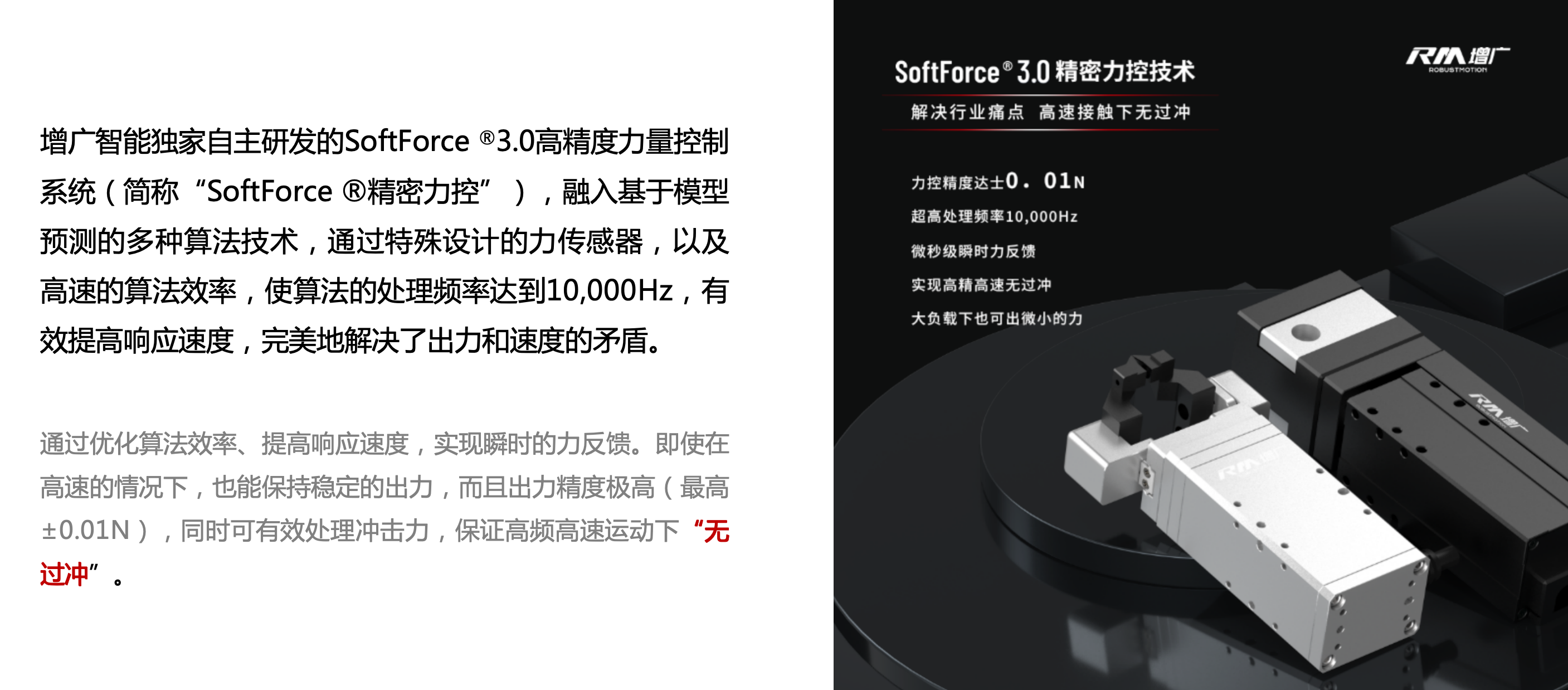
SoftForce® Precision Force Control
The Challenges Precision Manufacturing Poses to Conventional Grippers
When handling precision, miniaturized components, the limitations of conventional grippers (especially pneumatic grippers) are sharply magnified:
Missing force control leads to yield loss:
Precision components such as chips, optical lenses, and micro coils are often fragile and expensive, and extremely sensitive to contact force. Conventional grippers cannot control gripping force precisely and easily cause indentations, scratches, micro-cracks, or outright damage from excessive force, resulting in costly yield losses.
No process feedback makes consistent process quality management hard to improve:
Conventional gripping is an 'open-loop' process: the system cannot know whether the gripping force is appropriate or whether the workpiece is in place. This makes quality traceability (SPC) impossible, and when quality problems arise it is hard to find the root cause through data analysis.
Inability to execute complex force-controlled processes:
Many precision assembly processes — pressing flexible cables, mating micro snap-fits, in-line testing of elastic modulus — require more than 'gripping': they need a complex process involving precise force feedback and force-position coordination. Conventional grippers are entirely incapable of this.
Precision force-control electric gripper's core technical characteristics
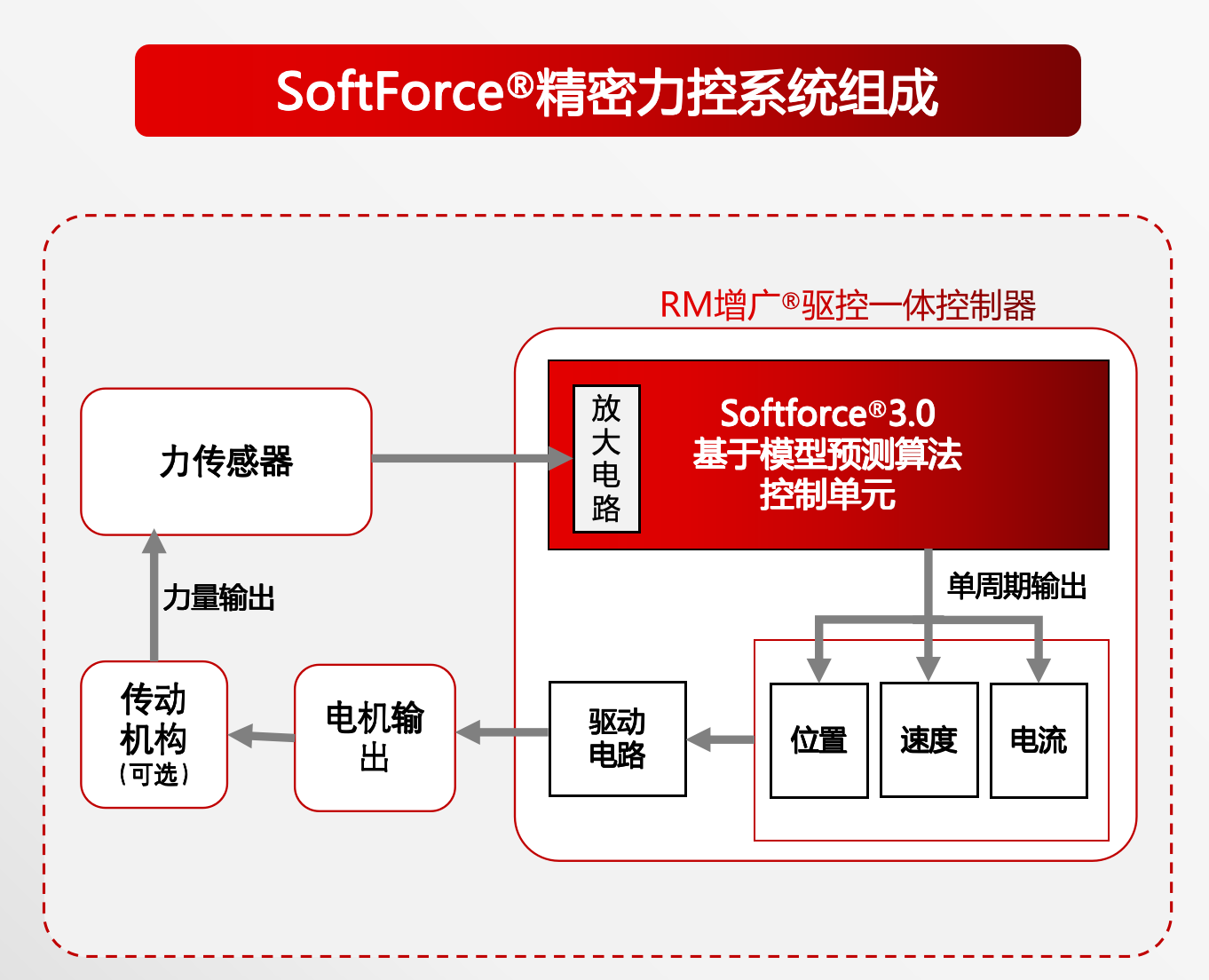
The precision force-control electric gripperis not simply an electric gripper: at its core is a genuine built-in closed-loop force control system. TakingRobustMotion'sprecision force-control series as an example, its key technologies include:
High-precision, high-frequency force sensing and closed-loop control:
This isthe precision force-control electric gripper'sfoundation. Through a built-in high-precision force sensor, it monitors the end contact force in real time at ahigh-speedresponsefrequency,feeding the result back to the controller.
Based onRobustMotion'sSoftForce™ core algorithm, the controller compares and corrects the target force against actual force at high frequency, achieving real-time, precise regulation of gripping force with accuracy up to ±0.1 N or even higher.
Force-position hybrid control capability:
The precision force-control electric grippercan not only control force but also move precisely under force control. It can move positionally under a set force threshold (such as force-controlled seeking), or switch to a precise force output mode upon reaching a target position. This coordinated control of force and position is the foundation for performing precision assembly tasks.
Full-process data acquisition and output:
Throughout the gripping or assembly process,the precision force-control electric grippercan fully record and output high-resolution 'force-displacement-time' curve data. This makes the production process thoroughly transparent, providing a valuable data foundation for process optimization, quality monitoring, and fault diagnosis.
The application valueof the precision force-control electric gripper
In precision manufacturing lines, introducingthe precision force-control electric gripperbrings revolutionary value:
- Safeguarding the yield of high-value workpieces:With force control accuracy on the order of one thousandth, precision workpieces suffer no damage during contact, gripping, handling, and assembly, reducing defect rates to a minimum.
- Automating precision processes that could not be automated before:Complex processes that once relied on skilled manual work — such as tight-fit assembly of IPEX terminals in phones, hot pressing of flexible screens, and elasticity testing of micro parts — can now be automated with high reliability.
- Enabling data-driven smart manufacturing:By providing complete force curve data, it helps companies build a quality traceability system covering the product's entire life cycle, upgrading from 'experience-based manufacturing' to 'data-based manufacturing'.
The precision force-control electric gripperis a new-generation intelligent actuator born to meet the challenges of precision and miniaturized manufacturing. Centered on high-precision closed-loop force control, and through force-position hybrid control and full-process data acquisition, it fundamentally resolves conventional grippers' lack of force control,blindpositionmotionand other problems. It is not merely a tool for gripping but a key technical component for achieving high-yield, highly reliable precision manufacturing and moving toward data-driven smart manufacturing.
Frequently Asked Questions
Q1: How can fragile, high-value precision workpieces such as optical lenses be gripped automatically without damage?
A: Use a gripper with high-precision closed-loop force control. By setting a minute, precise gripping force, excessive force is avoided throughout the operation, safeguarding yield at the root.
Q2: For assembly tasks requiring precise force feedback, such as connector insertion and key mechanics testing, how can automation be achieved?
A: Choose an actuator that supports force-position hybrid control. This technology monitors force in real time during motion, enabling force-controlled seeking, compliant contact, or precise force output at a designated position, thereby completing complex assembly processes.
Q3: How can processes in automated production be made transparent for quality traceability and process optimization?
A: Use an intelligent actuator capable of outputting full-process curve data. By acquiring and analyzing high-resolution 'force-displacement-time' process data, quality can be monitored for every operation and a data basis provided for process improvement.
Q4: What is the essential difference between a precision force-control electric gripper and an ordinary electric gripper plus an external force sensor?
A: The essential difference lies insystem integration and control loop efficiency.An integrated precision force-control gripper has extremely low internal latency and an extremely high control frequency, enabling highly responsive, highly stable dynamic force control that split designs can hardly match.












