
MagiFloater

How the “Flexibility” of a Force Control Gripper Is Achieved: A Breakdown of the Technical Principles
Published:
2025-11-14
Keywords: Rigid structure, Compliant gripping ,Closed-loop force control,Open-loop force control,Pressing motion,Absolute motion,Hybrid force/position control ,Servo drive,Force sensor,Adaptive grasping
Article summary:This article analyzes the technical implementation path of RobustMotion electric grippers' “rigid structure plus compliant control”. High-rigidity ball screws and guide rails ensure industrial-grade accuracy and service life, while combining [absolute motion] position control with [pressing motion] force control mode enables adaptive gripping that “stops when force is reached” based on current percentage settings. It highlights the essential difference between closed-loop and open-loop force control: the former achieves precise control through measured force sensor feedback, while the latter only estimates via current and carries a ±5% to 15% error.
In precision manufacturing, the definition of “flexibility” for end effectors has evolved from traditional physical-form adaptability to an advanced control capability based on high-precision closed-loop force control. For precision force control grippers, this “flexibility” specifically means: the ability to achieve overshoot-free soft landing with workpieces during high-speed motion; the ability to output and hold force values precisely as commanded; and the ability to execute complex force/position coordinated tasks. This article breaks down the implementation principles of this advanced “functional flexibility” from three levels: hardware foundation, control core and algorithm strategy.
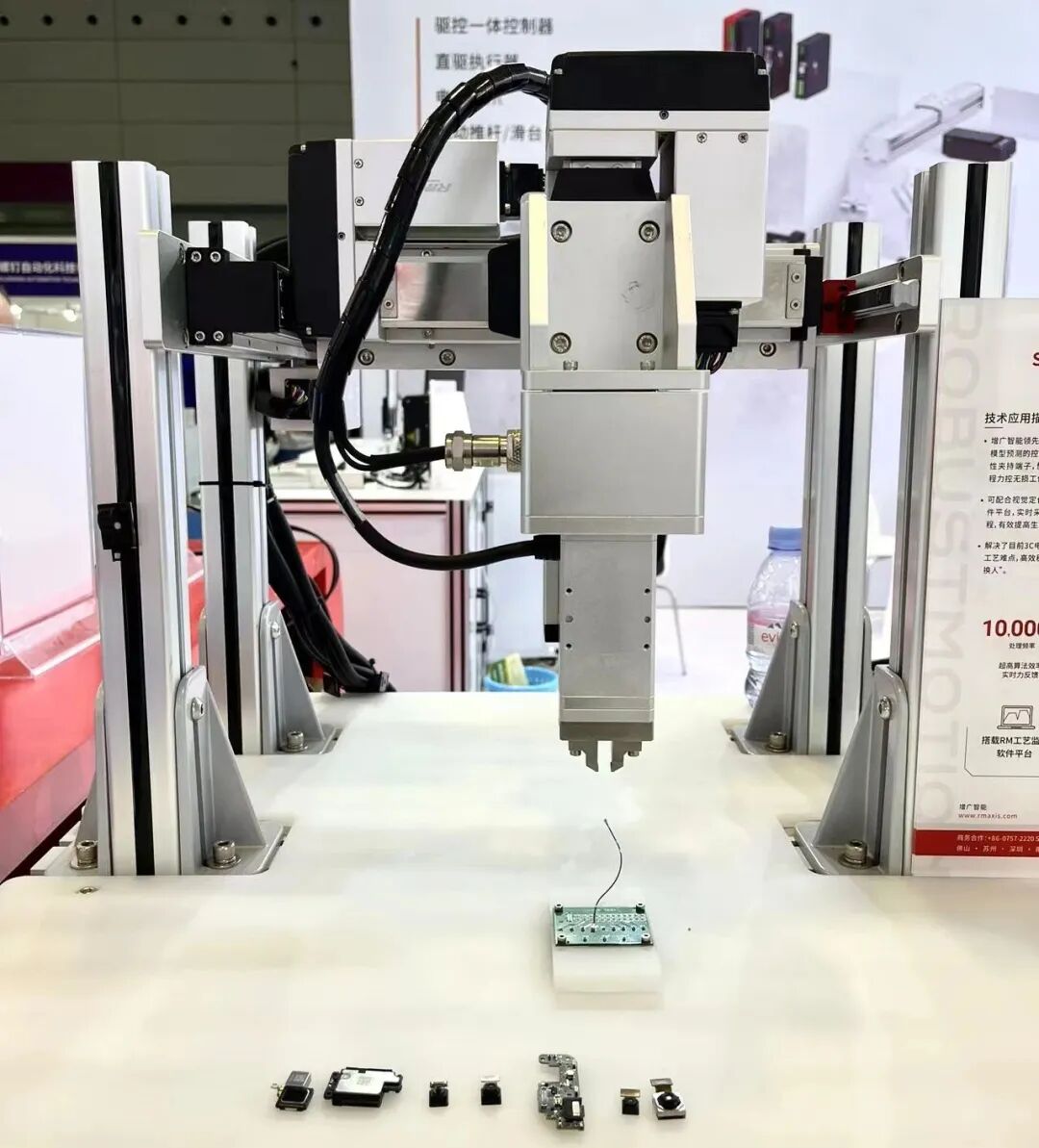
1. Physical layer: a highly responsive servo drive system
The foundation of all advanced control strategies is a physical system that can execute commands with high fidelity. The physical layer of a force control gripper consists of a precision, highly responsive servo drive system:
Core components:The system consists of a brushless DC servo motor, a high-resolution encoder (absolute or incremental) and a low-backlash precision transmission mechanism.
Function:This hardware combination provides the upper-level controller with precisely programmable control interfaces for position, speed and torque (via current). It ensures that every tiny motion or torque command issued by the controller can be executed quickly and accurately, which is a necessary prerequisite for high-dynamic force control.
2. Perception layer: a high-precision force feedback unit
To achieve true closed-loop force control, the system must be able to sense the end contact force in real time and accurately.
Technical approach:A highly sensitive, highly linear force sensor is integrated directly into the key force transmission path of the gripper or push rod. When the actuator end is loaded, the sensor captures the micron-level deformation of the structure in real time and converts it into a stable, precise electrical signal.
Technical advantage:This direct measurement approach fundamentally avoids the large errors that arise when estimating force from motor current, which are caused by non-linear factors such as transmission friction, clearance and temperature rise. It is an indispensable part of achieving high-precision, high-dynamic-response force control.
3. Control core layer: SoftForce®closed-loop force control algorithm
If the servo system is the limbs and the force sensor is the nerves, then the SoftForce®control algorithm is the brain. At a high processing frequency, it fuses perception-layer data and decides how to drive the physical layer, achieving dynamic and precise regulation of end force. Its core algorithm strategies include:
Hybrid force/position control: this is the key control mode for executing complex process flows. Taking precision press fitting as an example, the system can:In position mode,run at high speed to near the workpiece surface to ensure production takt. When the force sensor detects an initial contact force (e.g. 0.5 N), the control system immediately switches seamlessly to force control mode.In force control mode,perform the press-fitting action at a set constant force (e.g. 5.00 N) until the specified position or time is reached. The smooth, disturbance-free switching of this control mode is the core of balancing production efficiency and precision process quality. Functional flexibility defined by advanced control: the functional flexibility of RM RobustMotion force control grippers does not rely on deformation of mechanical structures but is defined through close hardware-software collaboration.
Execution foundation:A highly responsive servo system provides precise motion capability.
Perception entry point:An integrated high-precision force sensor provides real-time, accurate force feedback data.
Decision core:SoftForce®The control system runs advanced algorithms such as hybrid force/position control at ultra-high frequency to generate optimal control commands.
The deep integration of this technical architecture enables the system to complete the force control loop within an extremely short response time, thereby precisely generating and controlling a wide range of force output. As a result, whether handling high-value fragile parts such as semiconductor wafers and optical lenses, or performing precision processes such as grinding and testing that require constant force output, RM RobustMotion precision force control actuators can, with their outstanding functional flexibility—that is, precise, stable and controllable force output—significantly improve product yield, process stability and quality traceability for automated production lines.
Frequently asked questions
Q1: Many electric grippers on the market have force control. What makes your SoftForce® technology different?
A: We use a high-precision sensor at the fingertip tomeasure force directly, rather than the traditional method ofestimating force from motor current. Therefore our force controlis more precise and responds faster.
Q2: For gentle handling scenarios, why shouldn't I just use a pneumatic compliant gripper?
A: Because compliant grippers can be gentle but usually cannot be accurate. Our technology is designed forapplications that demand both high precision and compliant force control, and isa perfect combination of precision and flexibility.
Q3: What concrete benefits can hybrid force/position control bring to my production?
A: Simply put, fast first, gentle later. The gripper approaches at high speed to ensureefficiency, then switches to precise force control after contact to ensureyield, ultimately achievinga double improvement in efficiency and yield.。