
MagiFloater
Are Smart Electric Grippers Entering the '100-Yuan Era'?
Published:
2025-11-13
As the technology matures and reaches volume production, high-performance electric grippers have entered the '100-yuan era'. This price breakthrough has fundamentally shifted the cost balance when evaluating automation solutions. Beyond outperforming traditional pneumatic grippers in performance, they bring users far more significant cost-reduction and efficiency-gain value in total cost of ownership.
1. Lowering initial procurement and system build costs
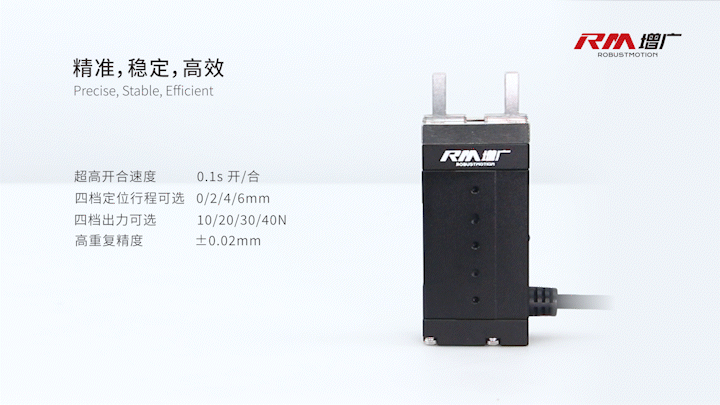
Procurement cost benchmark: the RM-EGB is priced in the same range as mid-to-high-quality pneumatic grippers (including solenoid valves, fittings and other accessories), removing the procurement barrier once created by the high price of electric solutions.
Eliminating air-supply system costs: choosing electric grippers means users need not invest in or build an entire air-supply system, including compressors,solenoid valves, dryers, filters and the complex air piping that runs throughout the workshop. For newly built lines or stand-alone workstations, the infrastructure cost saved is substantial.
2. Lowering integration and commissioning costs
Simplified electrical wiring: the RM-EGB adopts an I/O control logic similar to that of pneumatic solenoid valves, so electrical engineers can follow their familiar wiring practice. Compared with the dual 'air tubing + electrical wiring' of pneumatic solutions, the electric gripper needs only a single cable, simplifying system design and on-site installation and reducing both labour and material costs.
Ultra-simple commissioning: the EGB has multiple preset force and stroke levels that users can call up with simple combinations of I/O signals, with no need to connect software for complex servo parameter tuning. This greatly shortens the initial commissioning cycle, speeds up project go-live and delivers real cost reduction and efficiency gains.
3. Lowering long-term operating and maintenance costs
1) Significant energy savings:
Pneumatic systems suffer continuous energy losses. A compressor converts electrical energy into pneumatic energy at an efficiency of only about 50%, and leakage along the air piping wastes still more energy. Even when the gripper is idle, the system must maintain pressure and keeps drawing power.
Electric grippers consume power only while moving, with extremely low energy use during static clamping - truly delivering energy on demand. By measurement, under equivalent duty conditions the energy consumption of an electric gripper is only10% to20% that of a pneumatic solution, so the electricity saved over long-term operation is very substantial.
2) Reduced maintenance costs: in pneumatic systems, filter elements, sealing rings and the like are consumables that require regular inspection, servicing and replacement, and there is a risk of oil and water contamination. Purely electrically driven, the electric gripper has no fast-wearing parts and is virtually maintenance-free, lowering spare-parts inventory and maintenance labour costs.
4. Raising production efficiency through intelligent functions
Greater line flexibility: the force and position parameters of the RM-EGB are adjustable, so it quickly adapts to the production needs of different workpieces. Product changeover is done with a simple program switch, avoiding long downtime caused by replacing mechanical parts.
Less wasted time: the built-in 'empty-grip / drop detection' function spots production anomalies instantly, preventing the equipment from uselessly processing empty positions and increasing effective uptime, thereby achieving genuine efficiency gains.
The advantages of the economical electric gripper of the '100-yuan era' now reach far beyond performance. When total cost of ownership is assessed comprehensively - fromsystem build and integration/commissioning through to long-term energy and maintenance - the electric solution represented by the RM-EGB shows overwhelming cost advantages over traditional pneumatic solutions. It offers enterprises a better option that, with comparable initial investment, significantly lowers long-term operating costs while improving production efficiency and flexibility.