MagiFloater

Overshoot? Nonexistent! SoftForce®2.0 Precision Force Control, the “Hexagon Warrior” of Actuators
Published:
2022-05-17

At present, force control methods for the vast majority of actuators on the market fall into two categories:
A conventional force control method that is relatively easy to implement, achieving force control by regulating the current inside the motor. Its advantage is low implementation difficulty, enabling force control within a 5% to 15% accuracy range; its disadvantages are slow motion speed and no reverse transmission, so it cannot meet the needs of scenarios with higher accuracy requirements. After a period of use, mechanical wear introduces errors,further degrading accuracy.。
Such actuators usuallyhave no sensor, and even if a sensor is present it only serves to “display” force and does not participate in control. For example, adding a sensor to a press lets the sensor read the force magnitude and show the value on a display head, assisting manual adjustment of the force, but such adjustment generally has nothing to do with force accuracy.
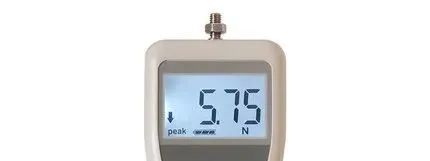
Illustrative image only
Another force control method adds a conventional force sensor and a conventional closed-loop control algorithm. Its advantage is improved accuracy, but its disadvantage is that speed remains relatively slow. This approach can raise force control accuracy from 5% to 1%. Without correct algorithm handling, or when the sensor is not fast enough, overshoot easily occurs.
Force control actuators
An unavoidable “overshoot”?
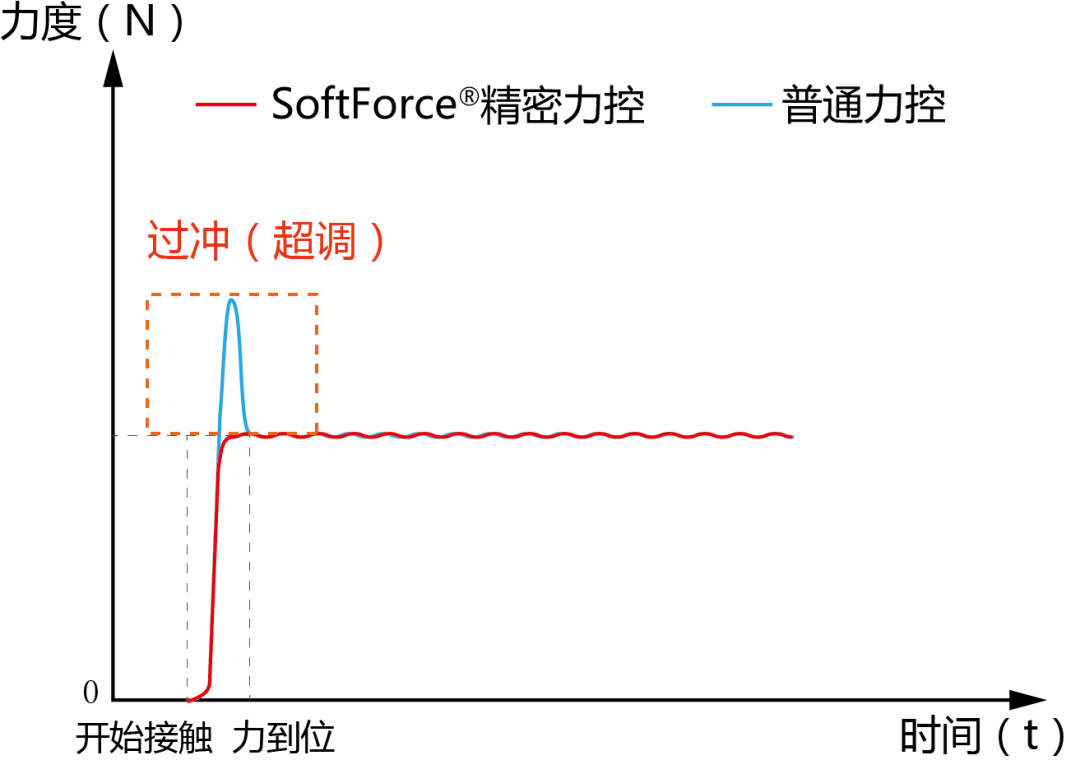
The sensor closed-loop force control method struggles to handle impact force, and the most direct manifestation is that, in scenarios with demanding takt requirements, overshoot appears very easily.Overshoot”。
Overshoot,also called over-travel, refers to force output exceeding its final steady-state value during motion. For example, in high-frequency, high-speed motion, the actuator's pressing force exceeds the set value at the instant it touches the workpiece due to the superposition of potential energy.
Because the motion is extremely fast, ordinary monitoring instruments cannot capture the output force at the instant of overshoot. When the actuator settles, the displayed force control indicator often still matches the originally set value, but in reality the force has already overshot at the moment of contact with the workpiece.
For fragile, high-precision and high-cost delicate parts, this directly damages the workpiece, and the most visible manifestation is that yieldstays low and cannot be improved.。
An example
Generally, at high speed and high output force, the force at the instant the actuator touches the workpiece is often particularly large. For example, with the actuator's pressing force set to 10 N, it easily reaches 11 N or 12 N at the moment of contact and is then pulled back to 10 N by the control algorithm. This problem frequently occurs with force-sensor-equipped and so-called force control actuators on the market.
This is the problem caused by insufficient response speed; high speed and precise, stable output force are inherently contradictory.If overshoot occurs, even the most accurate force at the target position is meaningless.
Especially in press fitting and precision assembly of fragile, high-cost parts, overshoot is generallynot permitted.。
Full-processforce control with high frequency, high speed and no overshoot?
How is it done?
For high-precision application scenarios, a “soft landing” approach is used to satisfy both high speed and high precision, namely staged force control. The actuator approaches the workpiece quickly in position mode, switches rapidly to force control mode at the position just before contact, and gradually increases output force until the preset value is reached. Position mode plus force control mode plus force settling time, added together, is the actuator's single-cycle execution efficiency.
RobustMotion's exclusively self-developed SoftForce®2.0 high-precision force control system (SoftForce® precision force control) perfectly resolves the contradiction between output force and speed: it maintains stable output force even at high speed, with extremely high output accuracy (up to ±0.01 N), while effectively handling impact force and guaranteeing “no overshoot” in high-frequency, high-speed motion.
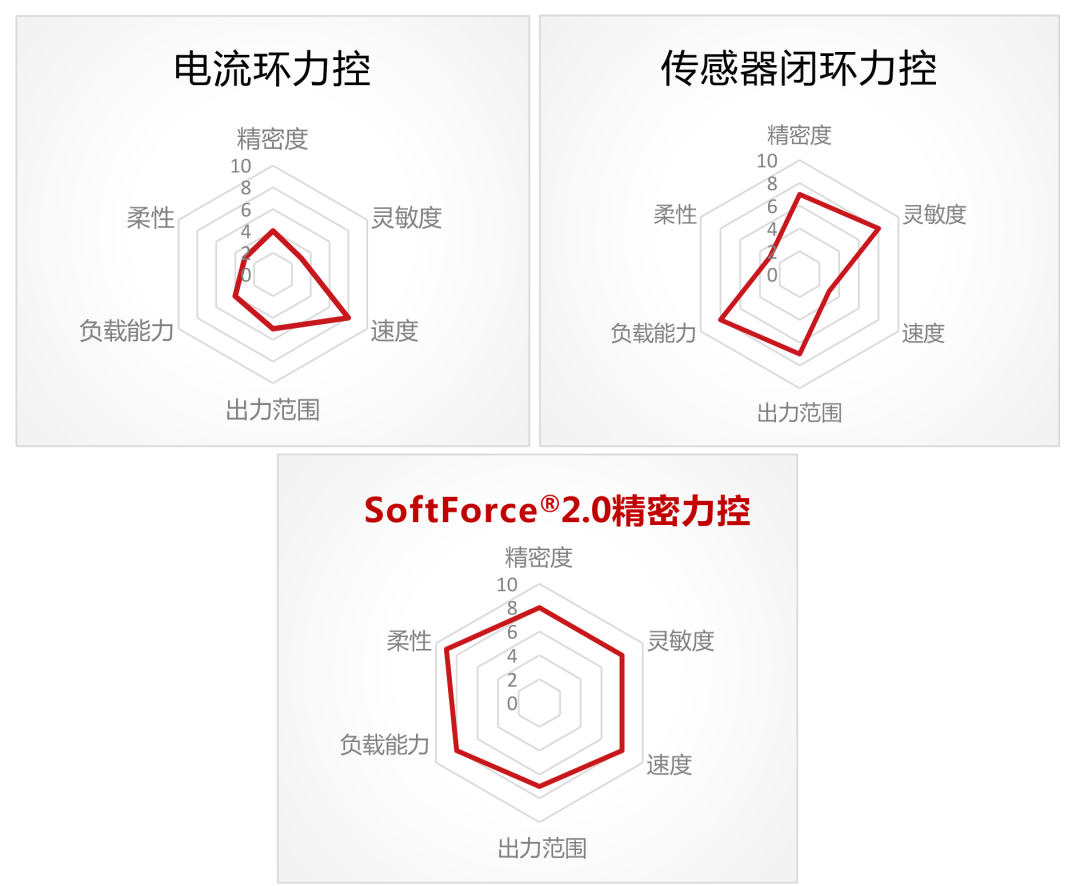
The all-round “hexagon warrior”
Combining a high-speed force sensor with a model predictive control algorithm, the SoftForce®2.0 precision force control actuator automatically identifies its own position and the contact state with the workpiece, giving the actuator—as the end of automation equipment—human-hand-like tactile perception, control and execution intelligence.
Over the same distance, SoftForce®2.0 precision force control widens the soft-landing speed range and tolerance, and can even achieve full-process force control, directly improving production takt and greatly reducing trial-and-error validation costs.
High processing frequency for better performance
The widely used “six-axis force sensor plus robot” force control solution on the market has a calculation cycle of 5 to 10 milliseconds, i.e. a processing frequency of 100 to 200 Hz. SoftForce®2.0 precision force control actuators reach a processing frequency of 4000 Hz (0.25 ms), and high-frequency series models can reach 8000 Hz—4 to 8 times the force control processing frequency of ordinary robots.
Active compliance force control that follows changes in external force
Efficient response rate and instantaneous force feedback let the actuator react instantly to external forces, achieving active compliance force control. Even when an external force is encountered during operation, it adjusts in time, making process completion more precise and better protecting the workpiece.
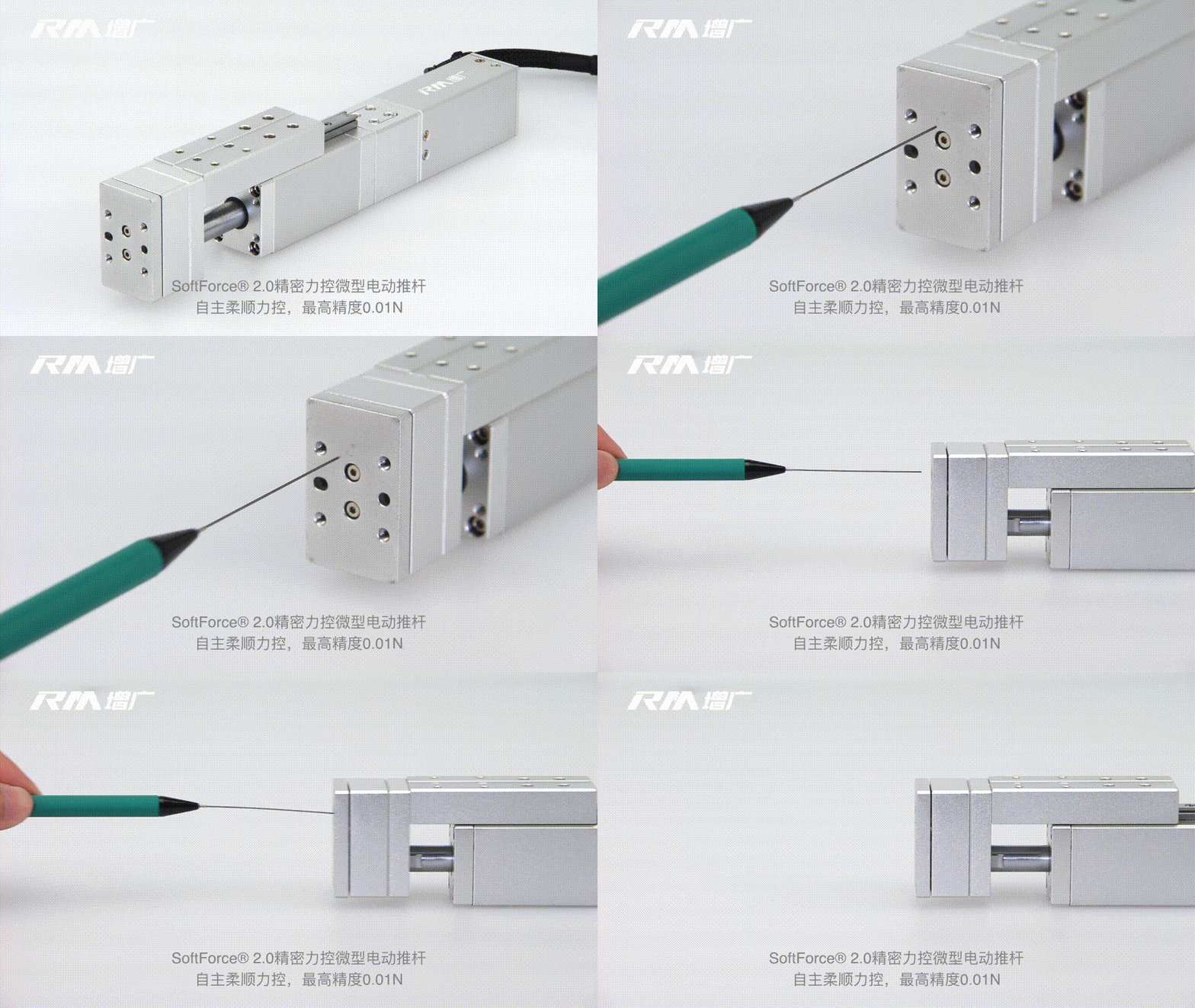
No overshoot at high frequency and high speed
Even in high-frequency, high-speed motion, it maintains high output accuracy while guaranteeing soft landing and no overshoot, contacting part surfaces with high speed and minimal force for compliant pick-and-place, avoiding damage to precision fragile parts.
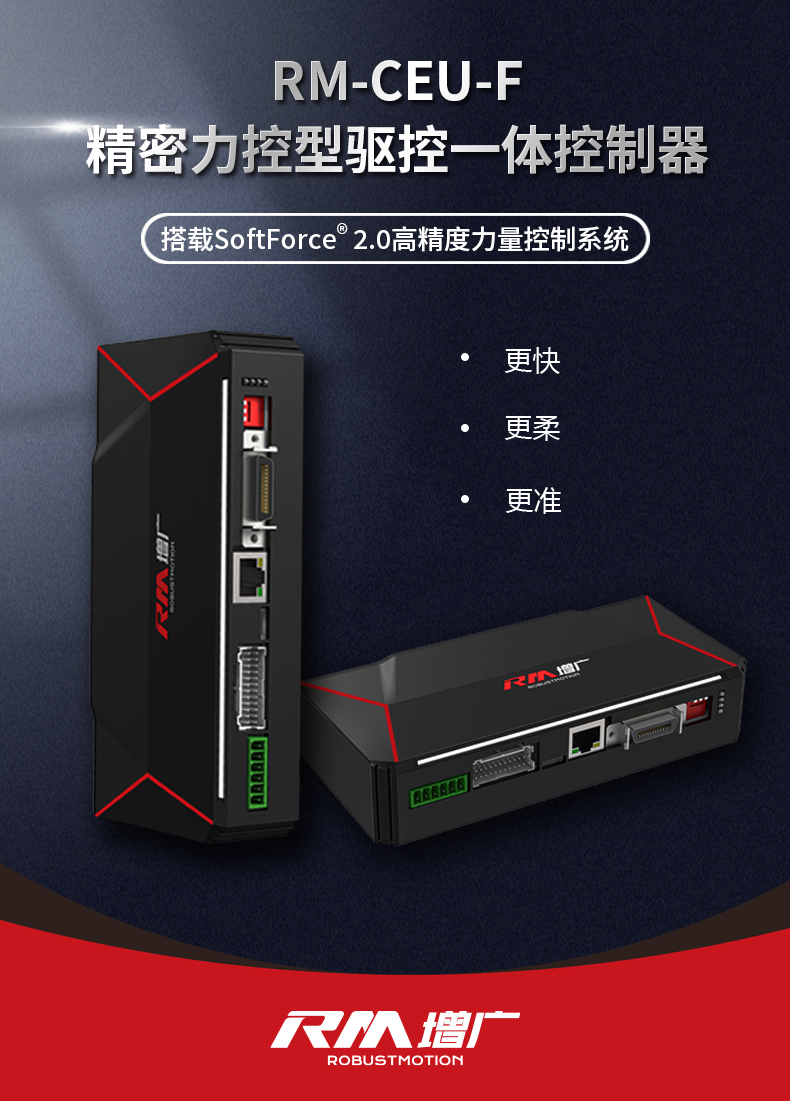
SoftForce®2.0 precision force control
HF series fully upgraded
Stronger overload resistance
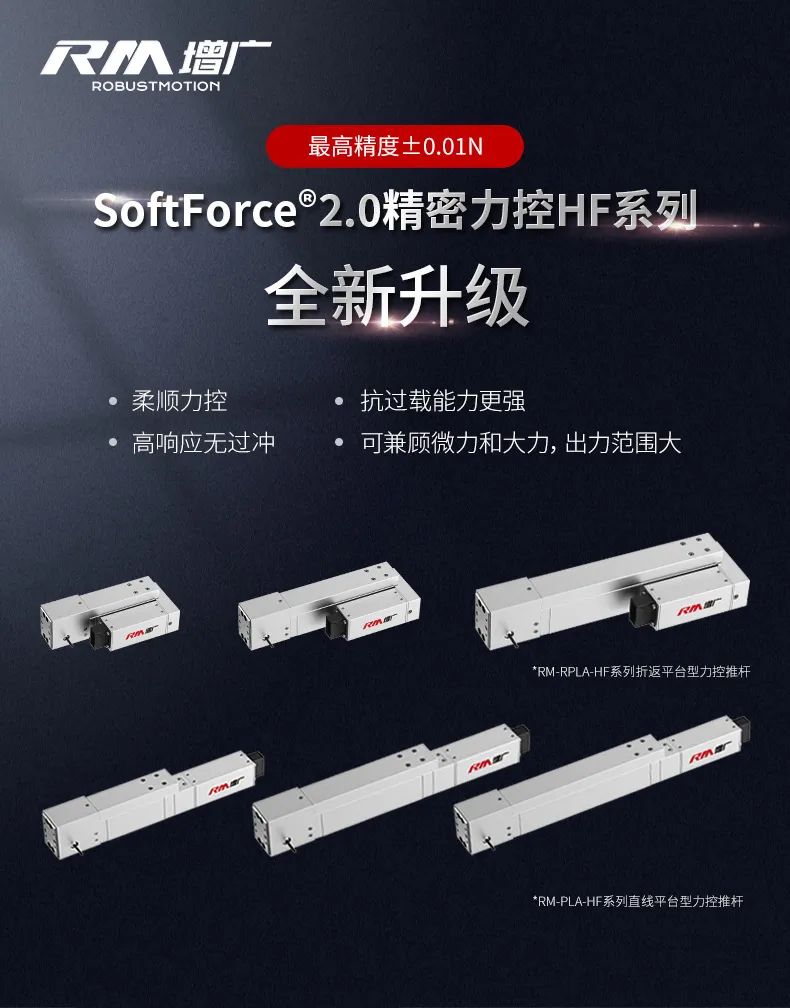
Based on deep understanding of on-site processes and multiple iterations, the SoftForce®2.0 precision force control HF series upgraded in February this year features an integrated sensor design, with overload resistance several times higher than before and greater durability, easily handling more complex working conditions.
Micro force and high output force at the same time
Precision force control slides and push rods with long stroke and large load, equipped with the SoftForce®2.0 high-precision force control system, can output micro, precise force under high load while also delivering high force, giving a larger output range—that is, a wider force dynamic range*.
*Force dynamic range: the ratio between the maximum and minimum force that can be output.
Can precision force control only be used on a single axis?
SoftForce®2.0Precision force control actuators can be used not only on a single axis but also open up more possibilities for multi-axis configurations. For example, RobustMotion's newly launched “RM RobustMotion two-dimensional synchronous precision force control platform control system” is built from two RM RobustMotion precision force control electric push rods and can replace the “six-axis sensor plus robot” force control solution for precision grinding and deburring of phone inner frames.
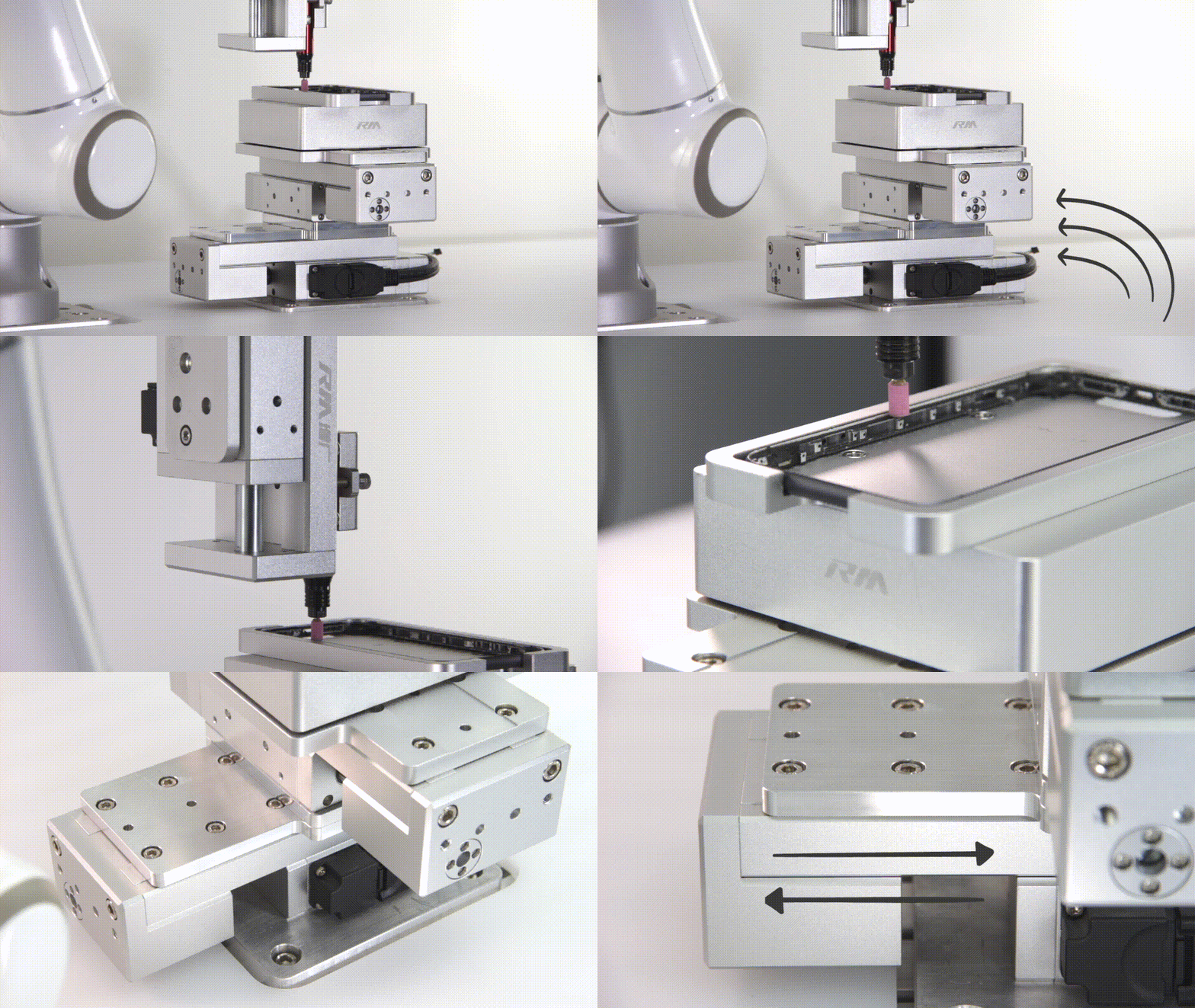
RM RobustMotion two-dimensional synchronous precision force control platform control system
(equipped with the SoftForce®2.0 high-precision force control system)
Precise, easy to use, professional service
Advanced control algorithms and a simple commissioning process bring customers a convenient user experience. Even operators without deep backgrounds can get started in 5 minutes—truly plug and play.
At the same time, RobustMotion's professional and capable after-sales technical service team can, whether for technical questions, teaching, fault handling or maintenance,at the first opportunityprovide customers with timely, comprehensive and worry-free technical support.
RobustMotion has always dared to push boundaries. With solid and innovative technical strength, it keeps launching higher-quality actuator products that are more intelligent, more precise and more compatible, providing advanced precision motion control systems and actuators and other core components for semiconductor packaging and testing, 3C automation, precision manufacturing, smart healthcare and other industries.
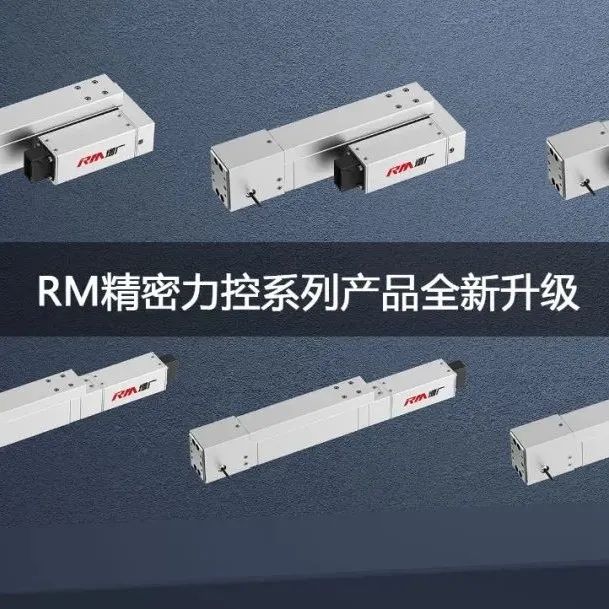
New Breakthrough in RM Force Control Technology! Force Control Performance Rivals the Human Hand

How Can More Functions Mean Simpler Use? The Ceiling of Domestic Controllers

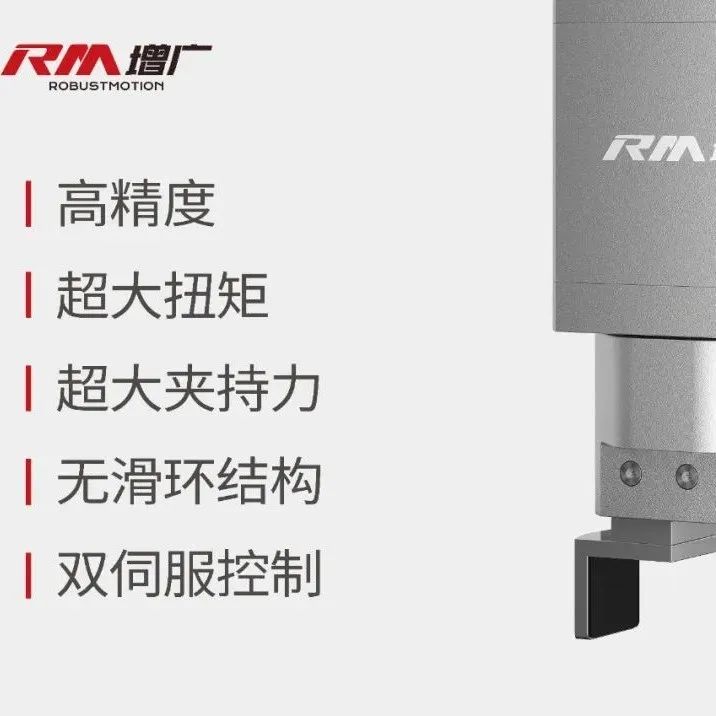

RobustMotion Technology Co., Ltd. (RobustMotion), a national high-tech enterprise integrating innovative technology R&D, production and sales,a leading provider of precision motion control systems and actuators.。
As one of the earlier domestic enterprises to enter the intelligent actuation system field, RobustMotion has, through its self-developed core precision motion control technology (Softforce® high-precision force control technology), created the “RM RobustMotion®” brand and independently developed and produced a series of leading actuators, including electric grippers, push rods, slides and direct-drive modules and other precision core components. Thanks to reliable quality, high precision, ease of use and convenient maintenance, RM RobustMotion products have steadily increased their share of the domestic actuator market and are widely used in 3C electronics, semiconductors, lithium battery manufacturing and inspection, biomedical, aerospace technology, intelligent manufacturing and other automation fields.