

MagiFloater

All Called "Force Control"—Why Does Performance Vary So Dramatically?
Published:
2025-11-25
Keywords: SoftForce®Precision Force Control,Current-Loop Force Control,Sensor Closed-Loop Force Control,Microsecond Control Frequency,Force Control Accuracy Tiers,Open-Loop vs. Closed-Loop,Constant Force Output,Electric Actuator Force Control,Hybrid Force-Position Control,Precision Assembly Force Control,Zero-Overshoot Force Control
Abstract:This article breaks down the three technological tiers of electric actuator "force control": Tier 1 is conventional current-loop open-loop estimation, Tier 2 is traditional sensor-based closed-loop control, and Tier 3 is RobustMotion's SoftForce® Precision Force Control. Only true closed-loop control powered by high-frequency algorithmic optimization can simultaneously achieve high speed, high accuracy, and heavy-load constant force output—preventing overshoot damage to delicate components in precision assembly, press-fitting, and testing.
In the era of pneumatic cylinders, "force control" was rarely discussed because motion was essentially position-driven. Today, as electric cylinders and (electric actuators) have become widespread, nearly every manufacturer claims "force control" capability. Yet in actual production, some "force control" solutions fall far short of expectations while others solve critical bottlenecks. Why does performance vary so dramatically under the same name?

Because "force control" technologies on the market generally fall into three distinct tiers.。
Tier 1: Conventional Current-Loop Force Control (Open-Loop)
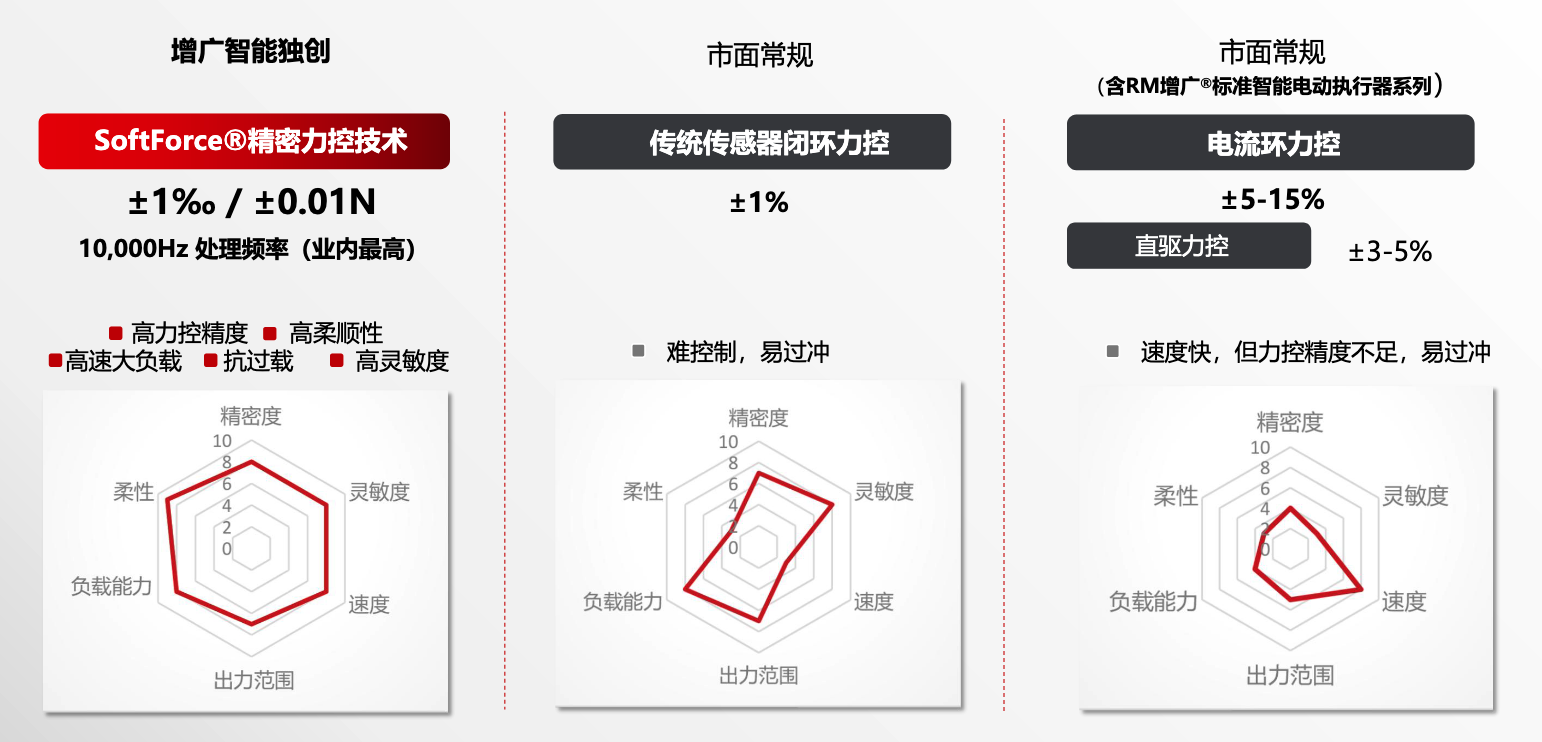
This is the most basic and common form of "force control," and it is fundamentally open-loop. It estimates output force by regulating servo motor current under the assumption that force is strictly proportional to current. Accuracy is low—typically around ±5% to ±15%. Command 100 N, and you might get 90 N or 110 N, with poor stability. While passable for rugged parts, it causes severe yield drops when handling delicate or brittle components. Without a force sensor providing feedback, the system is essentially operating blind regarding actual output force.
Direct-drive force control (such as linear motors) also exists on the market and improves accuracy to ±3%–5%, yet it still relies on current conversion without real-time force feedback, keeping it within the open-loop category.
Tier 2: Traditional Sensor-Based Force Control (Closed-Loop)
To overcome poor open-loop accuracy, many users bolt on an external force sensor or adopt third-party sensor feedback to form a closed loop.
This raises accuracy to roughly ±1%, but at the expense of sluggish system response and slower cycle times. Because an external calculation loop is added, pushing for speed causes oscillation, while maintaining stability requires slowing down. Some resort to mechanical spring buffers to dampen oscillation, which sacrifices valuable positioning accuracy—trapping engineers in a trade-off between speed and precision.
Tier 3: RobustMotion's SoftForce® e®Precision Force Control
Why does our technology earn the name "Precision Force Control"? Because it thoroughly resolves all of the challenges above.
While also utilizing sensor-based closed-loop feedback, RobustMotion SoftForce® ®Precision Force Control stands apart through its proprietary high-speed motion control algorithm. Extreme algorithmic efficiency pushes the force control loop processing cycle to the microsecond level! Ultra-high processing frequency enables razor-sharp current regulation, achieving 0.1%-class force accuracy (±0.1% FS) and up to ±0.01 N absolute precision. When commanding 100 N, our actuator holds steady between 99.99 N and 100.01 N—delivering virtually constant, zero-overshoot force output that protects delicate workpieces.
Even more importantly, we have resolved the fundamental conflict among accuracy, speed, and payload. Even while carrying heavy payloads at high speeds, the actuator maintains constant, minute, and precise force output.
Now the distinction is clear: from "current-loop estimation" to "traditional closed-loop" to "SoftForce® ®Precision Force Control," these represent three entirely different technological tiers. Next time someone pitches force control, ask three questions: Is it open-loop or closed-loop? What is the closed-loop processing frequency? Can it guarantee high speed and high accuracy simultaneously?
Frequently Asked Questions (Q&A)
Q1: How can you quickly distinguish "open-loop force control" from "closed-loop force control"?
A: Check whether a physical force sensor and real-time feedback loop are present. Open-loop schemes estimate force solely from servo current without a force sensor, resulting in poor disturbance rejection; closed-loop force control continuously measures actual output force and corrects deviations against the setpoint. A simple test: apply an external disturbance at the output tip (e.g., push against it by hand)—an open-loop system cannot sense the actual force change, whereas a closed-loop system immediately adjusts current to maintain the target force.
Q2: Why does traditional closed-loop force control suffer from "oscillation" or "slow response"?
A: Traditional setups typically rely on a PLC or external controller for force-position data exchange with millisecond-level communication cycles. Low control frequency creates high effective system lag: rapid force transitions cannot be corrected in time, causing oscillation, while lowering gain to suppress oscillation results in sluggish response.。
Q3:SoftForce®How is constant force maintained under heavy payloads and high speeds?
A: Through our proprietary high-speed motion control algorithm,, which calculates payload inertia and motion velocity in real time to pre-adjust current output and cancel inertial forces, while dynamically adapting control gains to compensate for velocity-induced force deviations during high-speed motion.