

MagiFloater

Where Exactly Does Closed-Loop Force Control Differ from Open-Loop Force Control?
Published:
2025-11-20
Keywords: closed-loop force control,open-loop force control,current-loop estimation,force sensor feedback, electric gripper,force control accuracy,adaptive gripping,RobustMotion
Abstract:This article takes a deep look at the essential difference in the "force control" technology of industrial electric actuators: open-loop force control (current-loop estimation) infers force values indirectly by controlling motor current, with accuracy of only ±5%-15% and no real force feedback, making it hard to handle precision scenarios; closed-loop force control measures with an end-of-effector force sensor and corrects in real time, realizing a complete "command-execution-feedback-correction" loop. The article reveals the "speed versus accuracy" dilemma faced by conventional closed loops and explains how RobustMotion achieves microsecond-level response through high-speed algorithm optimization, guaranteeing ±0.1% high accuracy without sacrificing production takt, and providing precise force control for dimensional tolerance and mixed incoming-material scenarios in 3C electronics, new-energy lithium batteries and other industries.Actuator。
In recent years, as electric actuators (also called "electric cylinders") have become increasingly widespread, the term "force control" has been heard more and more. But you may not know that the same "force control" can rest on fundamentally different technical principles. The "force control" mentioned by many products is in fact conventional current-loop open-loop force control. So where exactly does it differ from true closed-loop force control?
What Is Open-Loop Force Control? Estimating from "Current", with Accuracy Left to Chance
Open-loop force control, plainly put, means the drive achieves force control simply by judging and controlling the motor current. This is the most common approach for electric cylinders and actuators on the market today because it is the simplest to implement. But it has two fatal weaknesses: accuracy is not high, and tuning is difficult. Accuracy is typically between ±5% and ±15%. What does that mean?
Let us take an example: suppose you need to output 100 N of force. With open-loop force control at ±10% accuracy, the force actually output by the actuator may swing sharply between 90 N and 110 N. For rugged workpieces that can take punishment, this amount of error may be tolerable. But when you are working with precision, fragile workpieces, this 20 N error range may directly crush the product, and the yield rate just cannot be raised.
Why does this happen? Because it has no "sensor". The actuator itself has no force sensor for force feedback, so it has no idea how much force it is actually applying or whether the output force is correct. Some customers add their own force sensor, but only to check force values for observation during commissioning. The sensor itself does not take part in the control loop, so this approach is still essentially open-loop force control.
What Is Closed-Loop Force Control? Measuring with a "Sensor" and Correcting in Real Time
True closed-loop force control adds a force sensor at the end of the actuator and lets that sensor signal take part in the control computation, forming a complete "command-execution-feedback-correction" closed loop.
The process works like this: the drive reads the real force value fed back by the force sensor and compares it with the target force you set; as soon as there is a deviation, it immediately adjusts the motor output, adding back or reducing force so that the result is neither too much nor too little.
It sounds ideal, but conventional "sensor-based closed-loop force control" also faces a huge challenge: the conflict between speed and accuracy. Because an external sensor and a computation stage are added, the response time of the whole system becomes slower. To guarantee accuracy, speed has to come down, and the production takt slows with it. If you try to raise the speed, the actuator becomes very prone to force overshoot and oscillation at the instant it touches the workpiece (when force jumps from 0 N), which in turn damages the workpiece. Some compromised solutions, such as adding a spring at the end as a buffer, can indeed mitigate oscillation, but a spring has its own stiffness coefficient that changes with use, which again causes a loss of positioning accuracy.
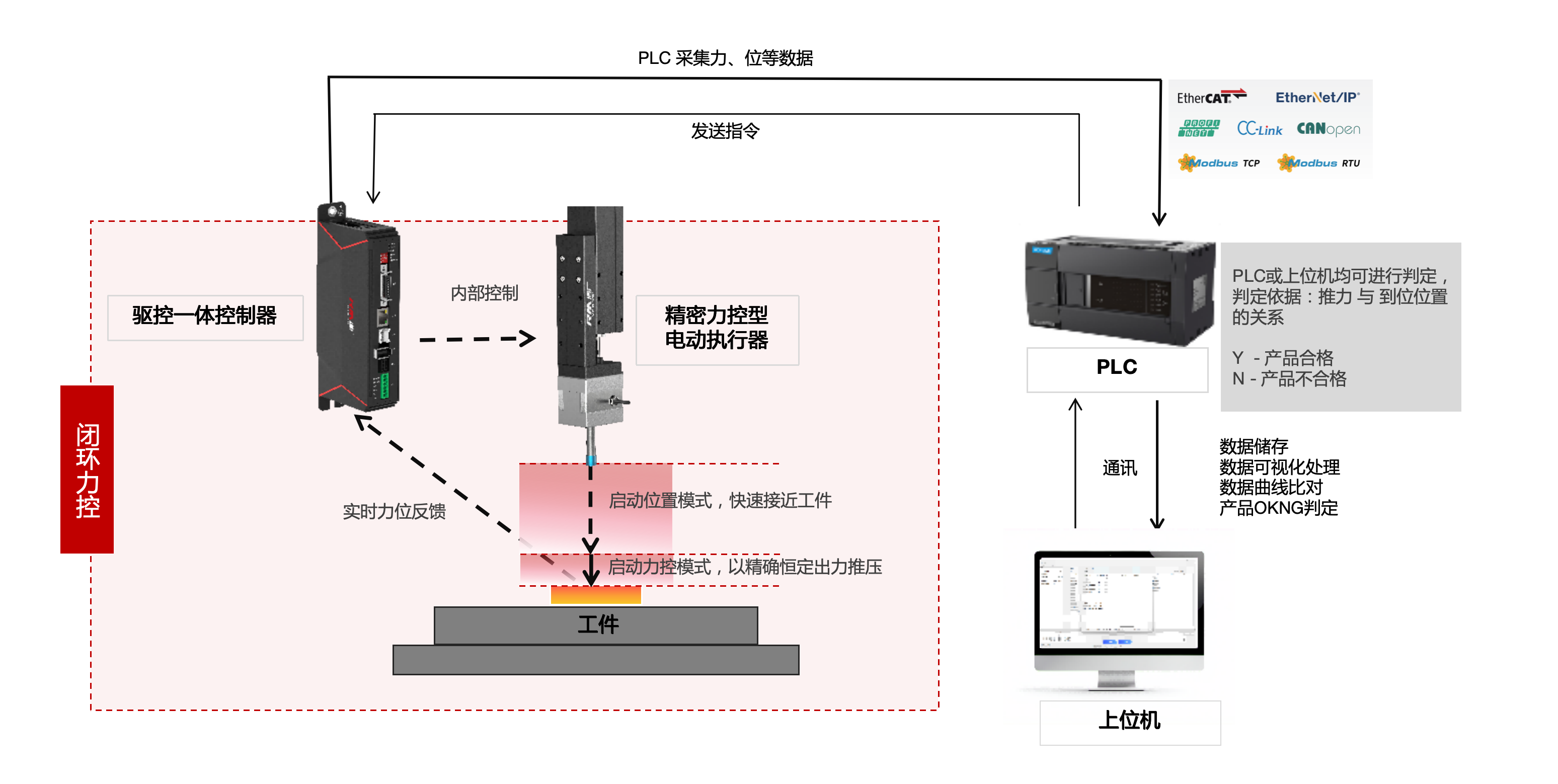
Conclusion:
The core difference between open loop and closed loop comes down to one sentence: whether the force sensor at the end takes part in the real-time force control computation.
Open-loop force control:It does not. What is controlled is current; force is only an estimated result.
Closed-loop force control:It does. Real force is controlled directly, so what you ask for is what you get.
Only by understanding this fundamental difference can you make the right judgment when selecting a product, and avoid paying for "pseudo force control".
Frequently Asked Questions
Q1: What is the essential difference between "closed-loop force control" and ordinary current-loop force control?
A: The essential difference is that one "guesses" and the other "measures". Open-loop force control guesses force by estimating motor current. Our closed-loop force control uses a sensor that measures force in real time at the fingertips, calibrating instantaneously to ensure the output force is absolutely accurate and stable.
Q2: My application only needs approximate force, so is open-loop force control not enough? Why must I use closed loop?
A: The "force" of open-loop force control keeps changing with speed, temperature and wear, so quality consistency is a black box. Closed-loop force control eliminates disturbances and ensures the same force is output every time, turning yield from a matter of luck into something that is 100% controllable.
Q3: Closed-loop force control sounds more complex. Will it slow down my takt or make commissioning more troublesome?
A: Quite the opposite. The closed-loop force control algorithm responds extremely fast, without sacrificing any production takt. At the same time, because force is set and measured precisely, during commissioning you only need to enter a target force value, which greatly simplifies the commissioning process。












