
MagiFloater

Applications of Precision Force-Control Electric Actuators in the 3C Electronics Industry
Published:
2025-11-26
Keywords: SoftForce®precision force control,3C electronics assembly,electric push rod,force-position curve,BTB mating,key tactile feel testing,self-aligning assembly,multi-dimensional force control,precision press-fitting,force-control electric gripper,automated inspection,consumer electronics manufacturing ,flexible assembly,RobustMotion
Article Summary Addressing the precision assembly and inspection challenges brought by the miniaturization and high integration of 3C electronic products, RobustMotion's SoftForce® precision force control technology offers a consistent replacement for manual work. High-response closed-loop force-control electric push rods and grippers enable key processes such as flexible BTB flex-cable mating, quantified key tactile feel testing, and self-aligning charging-port insertion and removal. The technology's core lies in real-time force-position curve acquisition and multi-dimensional force control algorithms, supporting a hybrid 'position + torque' control mode to ensure assembly yield and inspection consistency. The products support the Modbus RTU protocol and can integrate seamlessly into existing automated production lines, and are already widely used in the manufacture of smartphones, smart wearables, TWS earbuds, and other consumer electronics.
3C electronic products are iterating rapidly toward smaller size, higher integration, and more complex functions, which places ever higher demands on the manufacturing and quality control of all kinds of 3C products.Conventional position control or simple pneumatic solutions often fall short in the precision assembly and performance testing of tiny, delicate components. RobustMotion's precision force control technology has become a critical element of key processes at many leading manufacturing enterprises.
Precision Assembly: From Manual Work to Force-Control Automation
Smartphones contain numerous precision components such as micro terminals and flex cables. In assembly and inspection, low consistency, uncontrollable yield, and heavy reliance on manual operation have long been industry pain points. For example,mating the display's BTB flex cable usuallyrelies on manual operation; with automated equipment, inconsistent press force easily leads to incomplete mating or damage to the flex cable, and efficiency has been hard to improve.
UsingSoftForce® precision force-control electric push rods combined with coordinate signals from a vision system enables fast, precise force-controlled flexible press-fitting; gripping, alignment, and press-fitting can all be completed within seconds. High-response closed-loop force control ensures that mating depth and contact force are highly consistent every time, fundamentally improving assembly yield and reliability.
Precision Inspection: Quantifiable Tactile Curves and Segmented Force Feedback
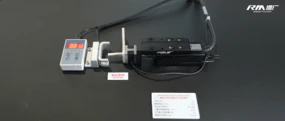
For parts users directly perceive, such as keys and fingerprint recognition areas, tactile feel and force feedback are key to the product experience, yet the forces involved are tiny and highly sensitive. With SoftForce®precision force-control electric push rods (RM-NPLA-HF) or SoftForce®precision force-control direct-drive electric push rods (RM-PVCS-HF), together with RMS process software, these tiny force-position data points can be acquired and turned into force-position curves, giving an intuitive, standardized judgment of each output force. This real-time data can be passed to a PLC or host computer for rapid OK/NG decisions, quickly determining in real time whether the inspected workpiece or product passes. This not only greatly improves the detection rate but also records and analyzes data from each press and inspection, continuously improving process quality.
Self-Aligning Flexible Mating and Assembly
For example, insertion and removal testing of charging ports on phones and other electronic products often requires dedicated equipment or workstations, which occupy significant floor space and involve complicated operation.RobustMotion's SoftForce multi-dimensional precision force control technology offers a more efficient and simpler solution.
By combining SoftForce®precision force-control electric gripperswith push rods, this multi-dimensional force control module achieves 'force-controlled self-alignment'. On contacting the edge of a charging port or other tiny socket, the system senses the minute resistance and automatically adjusts its position at a speed imperceptible to the eye until it finds the correct mating position, then completes insertion or removal with gentle force. Because force is precisely controlled and every motion stays within a defined force range, wear on plugs or ports caused by misalignment and excessive force is fundamentally eliminated.
RobustMotion's SoftForce precision force control technology has been widely applied in the production of all kinds of 3C electronic products, including smartphones, smart glasses, smart wearables, laptops, Bluetooth earphones, and various new intelligent consumer electronics. With its efficient algorithms and precise force sensing and control, it provides more efficient, more reliable, and smarter solutions for precision assembly, dispensing and lamination, precision inspection, and other key steps in 3C and many other industries.
Frequently Asked Questions
Q1: How does the force-position curve generated by RMS software quantify tactile feel?
A:Manual pressing is highly subjective and cannot be traced. RMS software acquires real-time force-position data through the RM-NPLA-HF/PVCS-HF, generates curves containing key parameters such as actuation force, return force, tactile point, and stroke, and automatically compares them with a standard template. For example,in watches,watch straps,matingand key inspection, differences in force feedback can be precisely identified, enabling standardized quantification of tactile feel and automatic OK/NG judgment.
Q2: How is the stability of micro-force control ensured?
A:3C components such as FPCs and micro terminals are extremely force-sensitive; even with ambient temperature changes or mechanical wear, force control accuracy remains within range, meeting the fragility protection requirements of micro components.
Q3:SoftForce®Is the technology applicable to industries beyond 3C?
A:The core value of precision force control lies in 'flexible contact plus quantified data', a need that is equally critical in medical devices, cosmetics, automotive electronics, and other industries. In cosmetics pump-head inspection, for example, force-position curves can identify differences in pressing force down to 0.5 N, ensuring a consistent user experience for every product. The SoftForce® technology platform can be transferred across industries, providing standardized solutions for any manufacturing scenario that requires precision force control.