
MagiFloater
Choosing an Electric Gripper on Stroke Alone? The Core Parameters Every Engineer Must Understand
Published:
2026-03-13
Once the application scenario is confirmed and you have decided to introduce an electric gripper, how do you find the model that best matches your project in a product parameter table? This article takes a deep dive into thethree groups of core parametersof electric grippers, clearing the fog and helping you understand the real engineering meaning behind the numbers.
1、The three fundamentals - deciding whether a gripper is 'up to the job'
These three parameters are the first hurdle in selection: they directly determine whether the gripper can successfully 'grab' and 'hold steady' your workpiece.
1. Effective stroke
- Parameter definition: The maximum travel distance of the two jaws from fully closed to fully open, usually in mm.
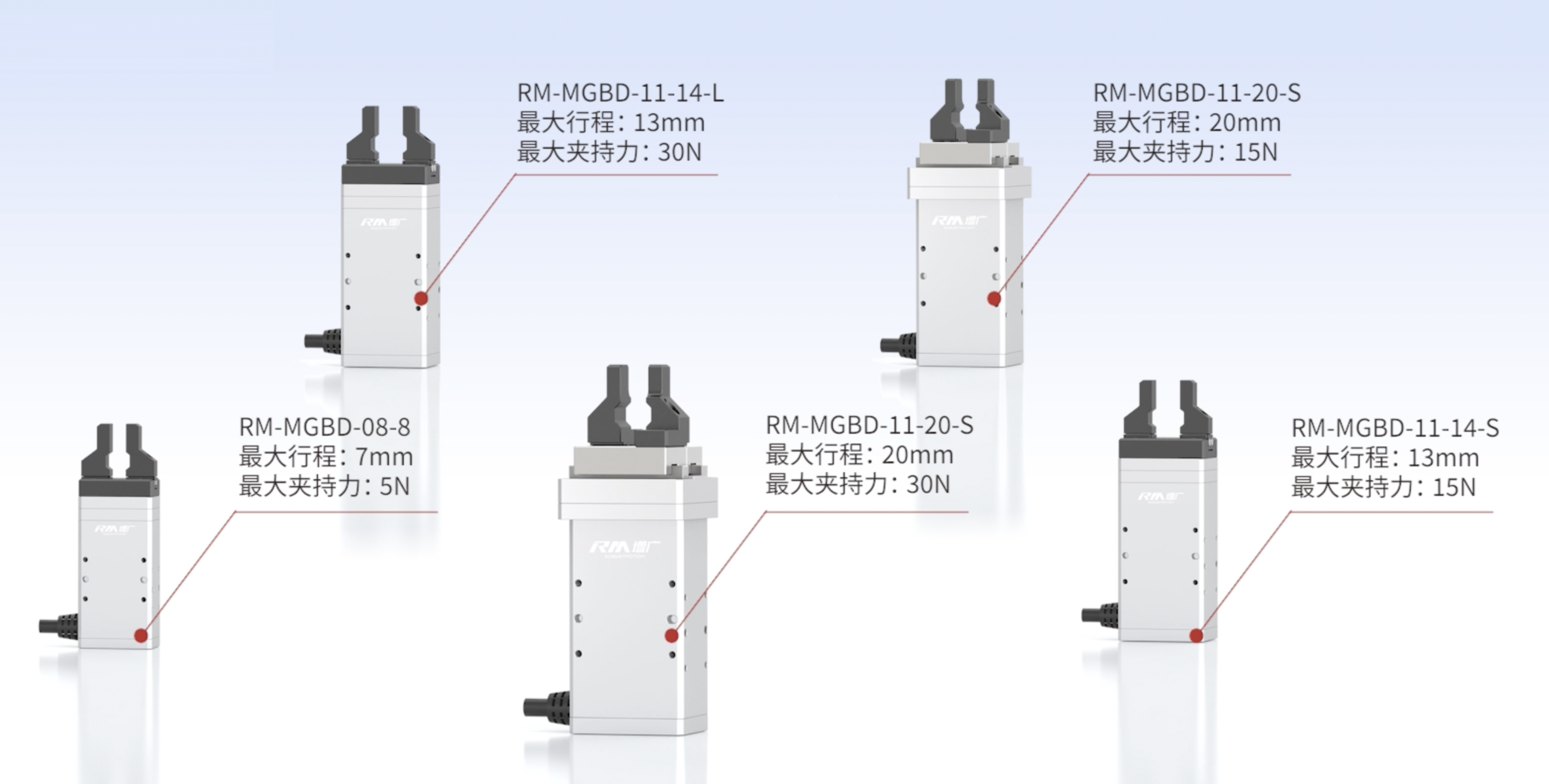
- How to select: What you should consider isnot the size of a single workpiece, but the size span of all workpieces to be picked on the line。
If you need to pick up two types of PCB boards with diameters from 10 mm to 30 mm, the required stroke is at least 30 mm - 10 mm = 20 mm. Choosing a gripper whose stroke fully covers the size variation range of your workpieces is the basis for 'flexible self-adaptation - one gripper, many jobs'.
2. Fastest open/close time
- Parameter definition: The shortest time the gripper needs to complete itsfull single-side strokeunder the maximum speed and acceleration settings, in seconds (s).
- How to select: This is the benchmark for the gripper's peak dynamic performance, butit is NOT the actual fixed cycle time. Thanks to servo control, the actual motion time is proportional to the travel distance you set.
Take the RM-MGBDas an example: a full stroke of 20 mm with a fastest open/close time of 0.25 s. But if the actual pick operation only requires the jaw to move 5 mm, the real elapsed time will be far less than 0.25 s. So when assessing throughput cycle times, estimate based on the actual working stroke.
- Parameter definition: The maximum force the gripper applies to the workpiece in the closed state, in newtons (N). It is the core parameter determining whether the gripper can 'hold steady'.
- How to select: Grip force is not better when bigger - too much damages the workpiece, too little drops it. Selection must consider the workpiece weight, the friction coefficient between finger and workpiece, and the acceleration during motion.
A practical rule of thumb is that the grip force should be at least 10 to 20 times the workpiece weight
2、The two precision factors - deciding whether a gripper is 'precise enough'
For advanced applications such as precision assembly or handling fragile parts, the following two parameters are decisive.
1. Repeatability (repositioning accuracy)
- Parameter definition: The consistency among the actual positions reached when the gripper repeatedly moves to the same target position, in micrometres (um).
- How to select: Critical in precision assembly, alignment and bonding applications. For example, inserting a tiny component precisely into a board socket demands very high repeatability as a precondition for assembly success.
2. Force-control accuracy
- Parameter definition: The consistency of the actual output force when the gripping action is repeated under identical settings. This parameter directly reflects the precision class of the force control.
- How to select:
- Conventional part handling: RobustMotion's standard intelligent electric grippers use current-loop force control or precision direct-drive force control, with force-control accuracy typically between ±5% to ±15% , enough for most conventional transfer tasks.
- Extreme precision handling: When you need to handle fragile items such as glass or chips, or perform precision force-controlled assembly, you must look at high-accuracy specifications. The recommended SoftForce® precision force-controlled electric grippermodels with a built-in sensor offer force-control accuracy reaching ±0.01N。
3、Integration and environment factors - deciding whether a gripper 'connects easily'
These two parameters determine whether the gripper can blend seamlessly into your existing machine 'brain' and harsh production environment.
1. Host control methods
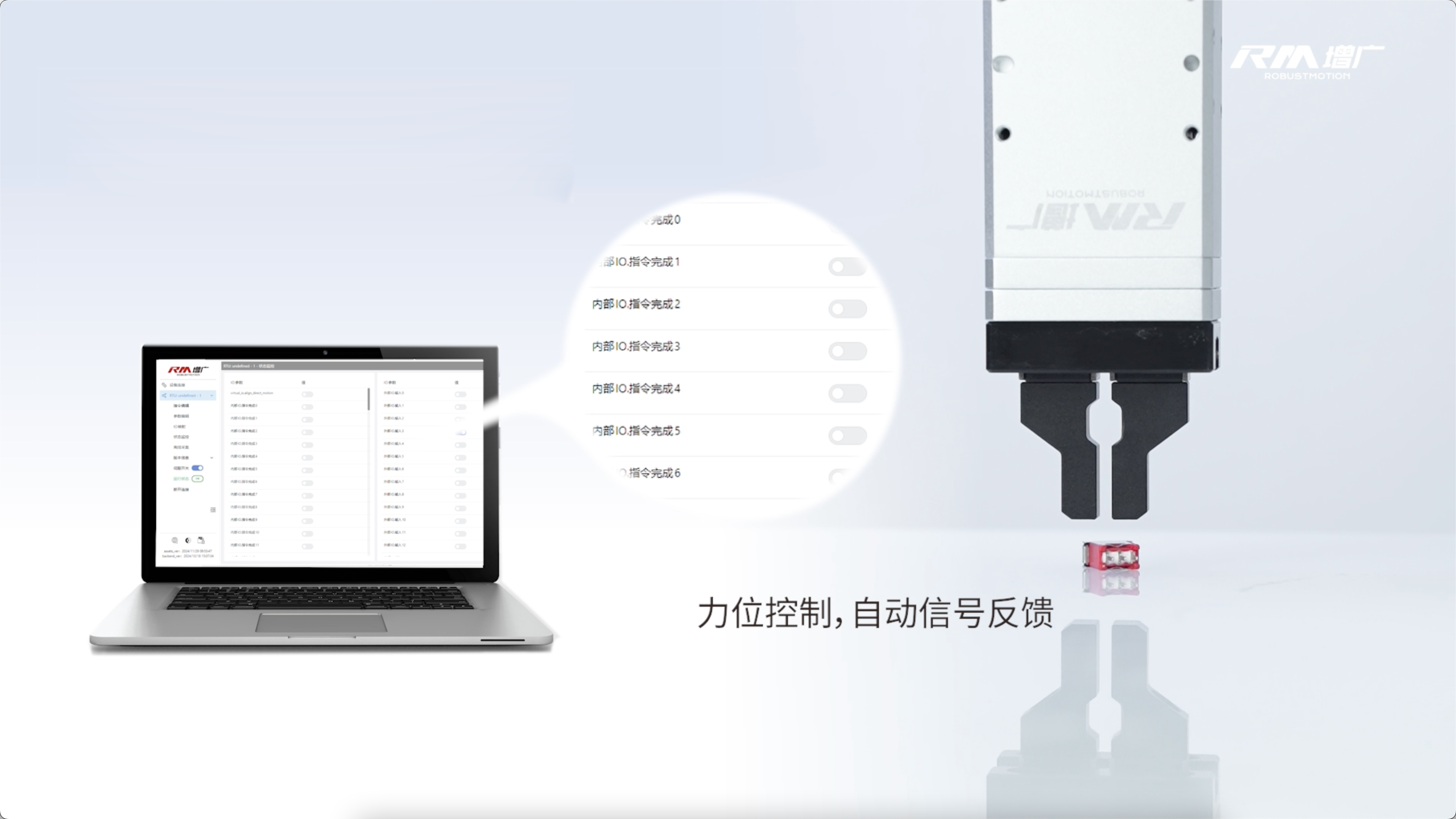
Refers to how the gripper communicates with your host controller (PLC, robot controller). RobustMotion offers a rich choice of architectures:
- I/O control: The simplest and most direct, like controlling a solenoid valve; ideal for quickly replacing pneumatic grippers or simple picking. Nearly all RobustMotion grippers (such as the RM-EGB、RM-GB-ITG series) support it, with abundant interfaces reserved.
- Pulse control: Position control via pulse signals (compatible with traditional stepper/servo practice). Note: purely pulse control is relatively uncommon for electric grippers.
- Industrial bus / Ethernet control (recommended): RobustMotion controllers (such as the RM-CEU、RM-CEP) natively support mainstream communication protocols including Modbus RTU/TCP, EtherCAT, CANopen, PROFINET, EtherNet/IP and CC-Link.No extra gateway purchase needed - true plug and play!
2. IP protection rating
The dust- and water-protection standard of the product; match it directly to your operating conditions. For ordinary environments a standard rating suffices; if the site involvesmachine-tool cutting-fluid splashing or wash-downand other harsh requirements, strongly choose an IP67-rated model (such as the RM-GBTD triple-protection gripper)to ensure long-term reliable operation.
Engineer's selectiongolden rules(recommended to screenshot and keep)
- Step 1: Usestroke, grip force and speedfor the initial screen to determine whether the gripper is 'up to the job'。
- Step 2: If precision operations are involved, userepeatability and force-control accuracyto assess whether it is 'precise enough'。
- Step 3: Check IP rating and communication busto confirm whether it 'connects easily'。
Once you understand the real meaning of these parameters, you can confidently select the right solution for your project