

MagiFloater

Resolution Is Not Force-Control Accuracy: How to Read Force Parameters When Selecting Electric Actuators
Published:
2026-07-24
Abstract: Resolution describes how small a force change a sensor or measuring system can detect, while force-control accuracy describes how close the actuator's actual output force is to the target force. The two mean different things, and selection should never rely on a single number expressed in N.
In datasheets for precision force-controlled actuators, different parameters may all be expressed in newtons (N), so they are easily confused. Resolution, force-control accuracy and repeatability in particular look similar but describe different capabilities of a force-control system.
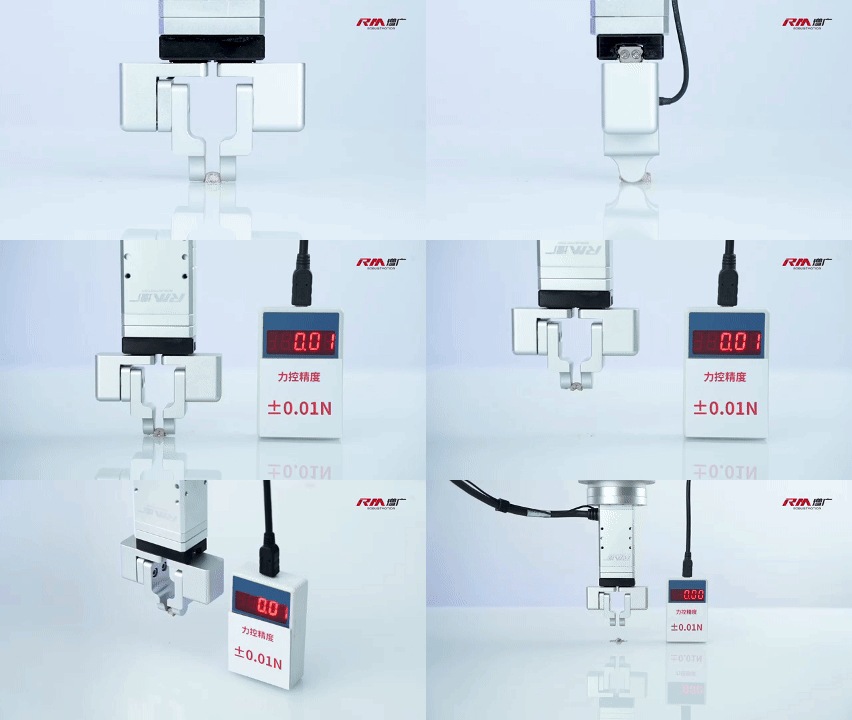
1. Resolution asks: can it detect the change?
Resolution describes how small a force change a sensor or measuring system can distinguish. The higher the resolution, the easier it is for the system to detect subtle force changes.
But resolution only reflects detection capability - it does not mean the actuator can certainly hold the force accurately near the target value. It is like a ruler with very fine graduations: fine marks do not guarantee accurate measurements.
2. Force-control accuracy asks: can it control to the point?
Force-control accuracy concerns how large the difference is between the actual output force and the target value once the actuator receives a target-force command.
It is not determined by the sensor alone: it also depends on the control algorithm, motor, transmission mechanism, mechanical friction, structural stiffness, mounting method and tooling load, among other factors. To judge an actuator's force-control capability, look at the complete system's actual output performance, not just the sensor specification.
3. Repeatability asks: is it consistent every time?
Repeatability describes how tightly the outputs cluster when the actuator executes the same force command many times.
Good repeatability does not mean the output is necessarily accurate. For example, a device may output very stably every time yet always deviate from the target: its consistency is good, but the actual control bias remains. Conversely, an average output close to the target does not mean every single result is sufficiently stable.
Therefore, processes such as precision assembly, press-fitting and force holding usually require attention to both force-control accuracy and repeatability.
4. How to avoid misreading parameters during selection?
When you see a force-control figure expressed in N, confirm the following in order:
- What does it describe?Is it resolution, force-control accuracy, or repeatability?
- Which model and range does it apply to?Different sensor ranges, actuators and lead-screw configurations can mean different values.
- What were the test conditions?Static force holding and high-speed contact are not the same duty; mounting orientation, speed and load also affect the result.
- Is there complete product documentation or test data?A figure is only meaningful for selection when the parameter name, applicable model and test conditions are all clearly defined.
5. How does RobustMotion (RM) specify force-control parameters?
RobustMotion's SoftForce® precision force-controlled products offer multiple configurations according to different actuators and sensor ranges, and the selection manual lists the closed-loop output range and force-control parameters for each corresponding model. The absolute force-control accuracy differs across ranges, so a single figure cannot represent the whole product family.
When selecting, first determine a suitable range from the maximum force your process requires, then, subject to meeting the output-range and overload requirements, choose the configuration best suited to precision control. For applications involving high-speed contact, long force-holding, or tooling loads, also confirm overshoot, holding stability and real-condition test results.
Conclusion
Resolution answers 'how small a change can be detected', force-control accuracy answers 'how close the output is to the target', and repeatability answers 'are repeated outputs consistent'. The three cannot substitute for one another.
For a selection engineer, what matters is not memorising one particular number, but first checking the parameter name, the applicable model and the test conditions, and then judging whether it truly meets the process requirement.












