
MagiFloater

Can an Electric Gripper Measure While Gripping?
Published:
2025-11-22
Keywords: electric gripper measurement, in-line measurement, dimensional inspection, Go/No-Go, workpiece sorting
Article Summary:In the pneumatic era, whether pneumatic grippers or cylinders, their actions were relatively simple — opening, closing, or pushing as air pressure changed. They were pure 'executors', unable to perceive the process and result of their own motion. With the arrival of the electric era, however, the introduction of electrical signals and advanced control technology means thatActuators such asRMRobustMotion'selectricactuators,integrate a high-resolution encoder internally,,combined withtheircomplete, programmable servo system,,can not only movebut also perceive, enabling a highly valuable function: 'motion as measurement'.
Controllable motion and position feedback:
Unlike cylinders that can only move between two points, RobustMotion electric actuators can position precisely at any point within their effective stroke. Users can, through software (such as RMScommissioningsoftware) or bus commands, program complex multi-point motioncommandcombinations.。
During motion, the built-in high-resolution encoder continuously feeds the gripper's real-time position back to the controller with extremely high accuracy.
How the measurement process works:
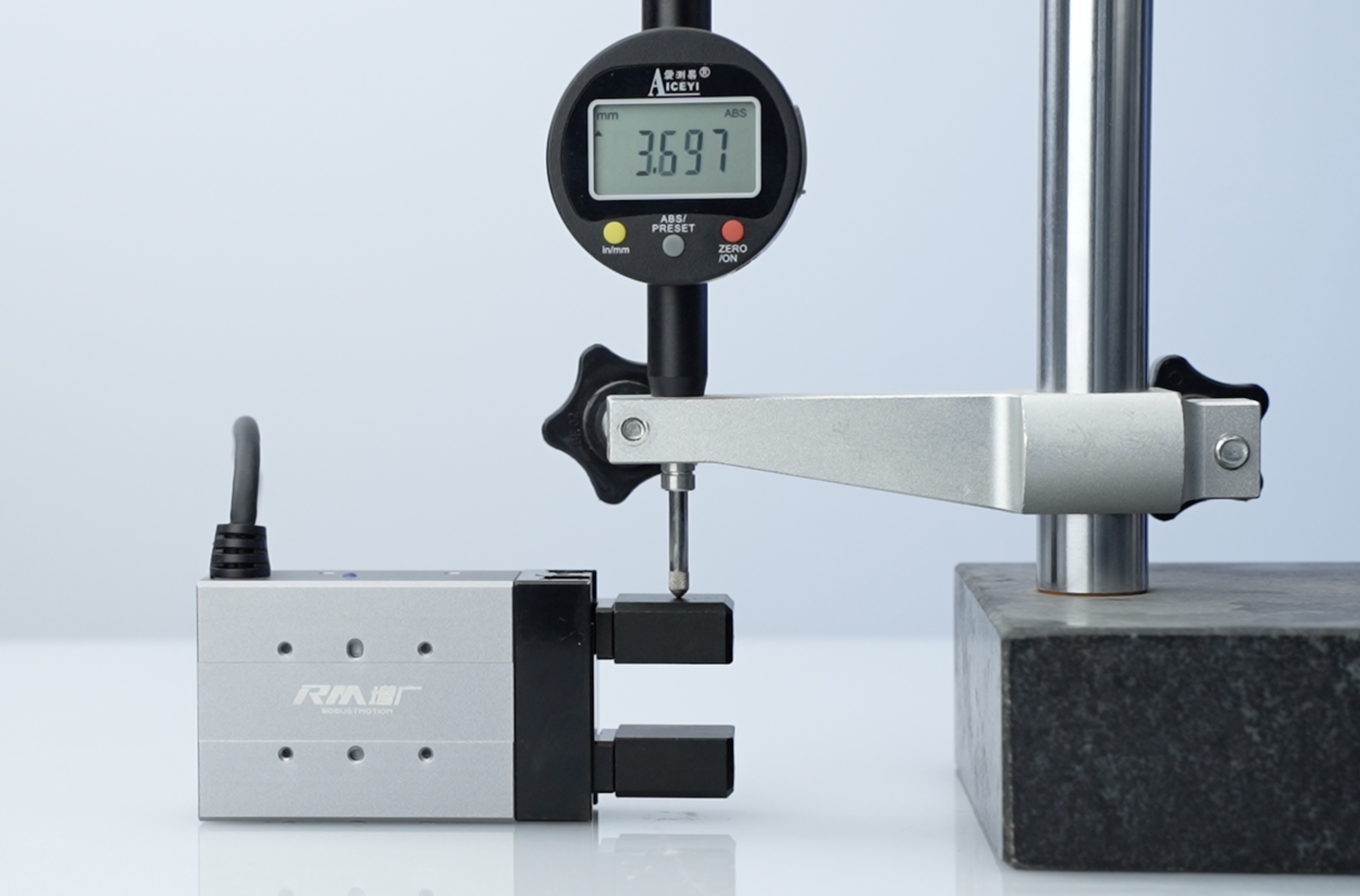
When theelectricgripper performs a gripping action (whether external gripping or internal expansion) and contacts the workpiece, the system can immediatelyfeed backpositionsignals.。
The host computer (such asa PLC) receives the position data and, with a simple calculation, can immediately derive the actual dimensions of the gripped workpiece (such as diameter or width).
Similarly, when an electric push rod (electric cylinder) presses a workpiece, precise feedback of its final stop position lets the host computer calculate in real time the height, thickness, or assembly depth of the pressed workpiece.
What does this capability bring to automated production lines?
Simplified processes, lower cost, higher efficiency
The most direct benefit is eliminating a separate measurement station. A flow that once required 'gripper picks up, move to vision or measurement station, measure' is now simplified to 'the gripper measures while picking up'. This not only reduces investment in vision systems or dedicated measuring equipment but also effectively shortens takt time.
Adaptive gripping and sorting for greater line flexibility
This is an important extended application of the measurement capability. When a line must handle workpieces of many different sizes,,through a mode in which 'measurement+and sorting”are synchronized',a single grippercan automatically identify and sort incoming parts, greatly improving line flexibility and adaptability.
Frequently Asked Questions
Q1: How does an electric gripper achieve measurement, and is the accuracy high?
A: It relies on the built-in high-precision encoder. When the gripper grips a workpiece, the controller precisely records the current finger position. From this position data, the host computer (PLC) can calculate the actual dimensions of the workpiece. Accuracy depends on encoder resolution and can reach very high levels.
Q2: What benefits does this 'measure while gripping' capability bring to my line?
A: The biggest benefit islower cost and higher efficiency.You can eliminate a separate vision or measurement station, simplifying the process and shortening takt time. At the same time, it enables fast in-line sorting of workpieces, for example judging whether incoming parts meet dimensional requirements (Go/No-Go).
Q3: Can this capability only measure external dimensions?
A: No. When the gripper performs internal expansion, it can equally measure the inner bore diameter of a workpiece. With an electric push rod, it can measure height, thickness, or assembly depth. The applications are highly flexible.