

MagiFloater

Selecting an Electric Gripper, Step One: What Information Do You Need to Confirm?
Published:
2026-04-29
The first step in electric gripper selection is not rushing to flip through product catalogs for a model number, but clarifying the workpiece and application scenario information first. Many engineers skip this step and end up with a gripper whose force or stroke is insufficient — or find there is not enough space once it is installed. This article covers three key points that clarify the information to confirm before selection.
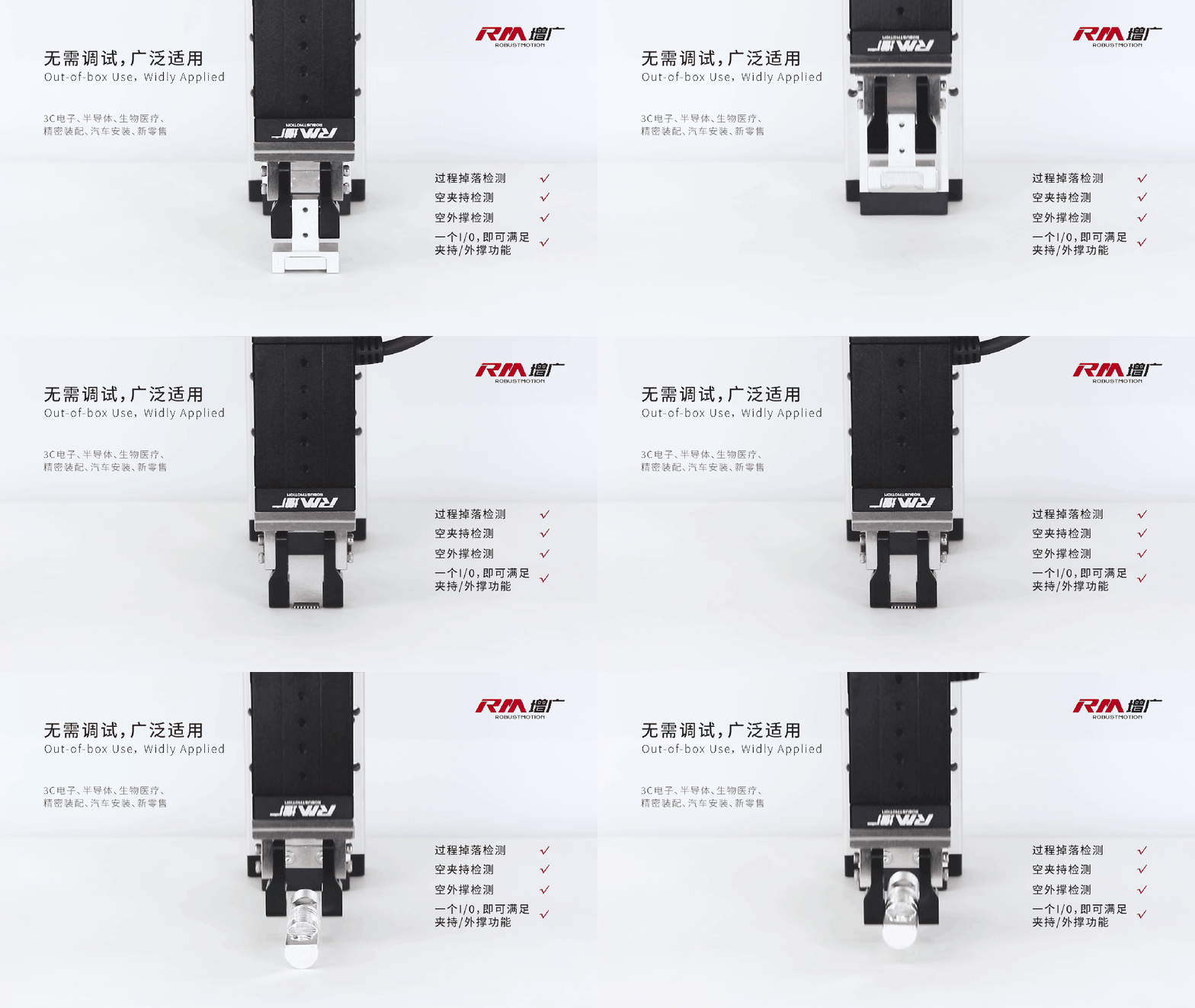
1. Workpiece characteristics: size, shape, weight and material
1. Workpiece size
The external dimensions of the workpiece must be clarified, especially dimensions related to gripping. For external gripping, the maximum outer diameter or maximum width of the workpiece is needed; for internal gripping, the inner bore diameter. If multiple workpiece specifications must be accommodated, record both maximum and minimum dimensions — this difference directly affects stroke selection. The RobustMotion RM-EGB series offers per-finger strokes from 0–10 mm, while the RM-GB series covers 20–220 mm, allowing flexible matching to workpiece size ranges.
2. Workpiece shape
Workpiece shape determines how the gripping surface is designed. Cylindrical workpieces suit V-shaped gripping surfaces, square workpieces suit flat gripping surfaces, and profiled parts with bosses, grooves or thin walls require custom contoured gripping surfaces. RobustMotion can provide gripping solution recommendations for special-shaped workpieces in cooperation with users.
3. Workpiece weight
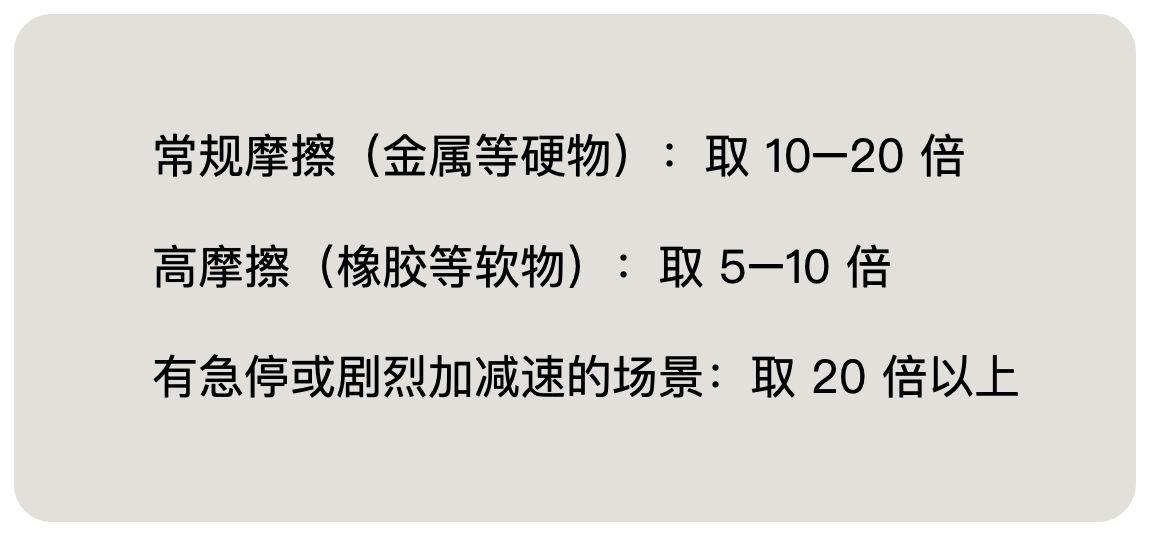
Workpiece weight (in g or kg) is the basis for calculating gripping force. An electric gripper holds the workpiece by friction, so the gripping force must exceed the workpiece weight with a safety margin, usually by applying a safety factor:
4. Workpiece material and condition
The workpiece material determines the friction coefficient. Metal parts have a low friction coefficient and require greater gripping force; soft materials such as rubber and silicone have a high friction coefficient and require relatively less. Whether the workpiece surface is easily scratched is also an important consideration. For tiny, fragile workpieces such as optical components and precision electronic components, precise control of gripping force is especially important. RobustMotion's SoftForce® precision force control series achieves force control accuracy up to ±0.01 N and is suitable for such small, fragile, easily deformed and high-value workpieces.
2. Working conditions and use: motion type, cycle time and force control requirements
The workpiece determines what is gripped; the working conditions determine how. Different working conditions place very different demands on the gripper.
1. Process motion type
First clarify what motion the gripper performs in the process flow:
Pick-and-place / transfer:Moving a workpiece from one position to another requires fast opening and closing. RobustMotion RM-EGB-06H has an open/close time of about 0.5 s open + 0.5 s close, suitable for production lines with demanding cycle times.
Assembly:Holding the workpiece for insertion, pressing and similar operations requires precise position control.
Cap tightening / screw tightening: requires coordinated rotation and gripping, i.e. torque control.
Inspection / measurement:Requires precise position feedback while gripping the workpiece.
Deviation correction / centering: corrects the workpiece position while gripping, requiring high-precision position feedback.
2. Production line cycle time requirements
How much time is allowed per workpiece for pick-and-place? A typical electric gripper opens in 0.5 s and closes in 0.5 s, so a single pick-and-place of about 1 second is already a fast cycle. The tighter the CT requirement, the more you need a model with fast open/close speed; when CTis loose, priority can be given to force control accuracy or other functions.
3. Is force control needed?
If the workpiece is fragile, a precision part or high-value (such as optical components or precision electronic components), confirm the precise gripping force control requirements. RobustMotion's standard series achieves force control accuracy up to ±0.01 N, meeting most precision gripping scenarios.
3. Gripping method and environmental adaptation
Having confirmed the workpiece and working conditions, also consider the gripping method and how the installation environment affects selection.
1. Gripping method: external or internal
External grippingis the most common method: the gripper clamps from outside the workpiece, suitable for solid workpieces and parts with regular outer diameters. For external gripping, also confirm whether outer diameter inspection is required.
Internal grippingmeans the gripper expands outward from inside the workpiece, suitable for tubular, ring-shaped workpieces or parts with inner bores. Internal gripping requires the gripper first to close to a small enough size to enter the bore, then open and expand — so both small entry size and large expansion must be satisfied. For internal gripping, also confirm whether inner diameter inspection is required.
2. Installation space
Confirm the available space at the gripper mounting position, and measure the mounting surface dimensions, available length and width. The RobustMotion RM-GBM slim miniature gripper has a body thickness of only 29 mm, suitable for width-restricted installations. Also confirm the threaded holes and hole diameters on the mounting surface to ensure reliable fixing and no interference with surrounding equipment during opening and closing.
3. Environmental conditions
Is there cutting fluid, dust or chips in the installation environment? If so, choose a model with a high protection rating. The RobustMotion RM-GBTD three-proof gripper achieves IP67 protection — water-, dust-, corrosion- and chip-resistant — suitable for harsh environments such as machining and cleaning lines.
4. Communication and control method
How does the system control the gripper?
I/O control (NPN/PNP signals):Simplest, suitable for simple motions at fixed points.
Industrial bus: suitable for multi-axis synchronization and complex control. RobustMotion supports mainstream industrial bus protocols such as EtherCAT, Modbus RTU/TCP, PROFINET and CC-Link.
Pulse control:Controls gripper motion via pulse signals.
5. Power supply and end-of-arm mounting
Confirm the system supply voltage and current output capability. RobustMotion actuators use a standard voltage of DC 24 V (±10%), and some products support DC 48 V.
If the gripper is mounted at the end of a robotic arm, comprehensively consider the arm's payload capacity and the workpiece weight, choose a model with suitable self-weight, and confirm whether the flange bore and wiring method match. The RobustMotion RM-EGB weighs only 0.22 kg and the RM-MGBD only 0.3 kg, suitable for scenarios with limited payload at the end of the arm. Integrated (ITG) models come with a built-in controller, simplifying wiring and suiting equipment integration scenarios.
Six quick steps for selection
1. Calculate gripping force: gripping force (N) = workpiece weight (mg) × safety factor
2. Determine stroke: stroke > maximum gripping dimension of the workpiece + clearance per side × 2 (reserve 1–2 mm per side)
3. Match the model: based on gripping force and stroke, filter models in the selection table that meet the requirements
4. Filter by working conditions: further filter by speed, accuracy, protection rating, etc.
5. Torque check: according to the gripper finger length, check against the load torque parameters in the product manual (MP, MR and MY directions)
6. Confirm communication and controller: integrated models work by connecting the I/O signal directly; split-type models require the corresponding integrated drive-and-control controller.












