
MagiFloater

Can a rigid gripper be highly flexible too?
Published:
2025-11-21
In automation, grippers are usually divided into two categories:rigid grippers and flexible grippers. The former excel in high precision, high speed and large gripping force, suiting standardized, high-intensity tasks; the latter imitate the human hand and can adapt to irregular shapes, but usually compromise on precision, speed and service life.
So a seemingly contradictory question arises: can a structurally rigid gripper also offer the 'high flexibility' needed to handle diverse, fragile objects? The answer is yes.
The heart of a smart gripper's flexibility: advanced control algorithms
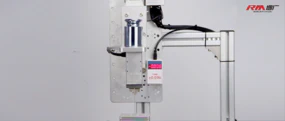
RobustMotion's smart electric grippers are a typical rigid structure, yet their flexibility and self-adaptation come from built-in advanced control algorithms. The key is that the algorithms give the gripper intelligent mode-switching capability.
What the algorithms do is to tightly combine motion commands with force monitoring. When the user issues a close command, the gripper starts moving; at the same time its internal control system monitors load changes in real time throughout the whole stroke. As soon as the fingers touch the workpiece the load rises sharply, and once the system detects that this force has reached the user-preset threshold, it immediately terminates the current motion command and holds the workpiece securely.
This means that, whatever the actual size of the workpiece, the gripper can judge at the very moment of contact whether gripping is complete by sensing force precisely. Instead of blindly running the entire displacement stroke, it stops exactly where it should, which avoids over-squeezing the workpiece.
Core advantages brought by RM RobustMotion's intelligent control
1、Extremely fast response: because force sensing and action judgement are completed entirely inside the drive, the response is extremely fast with almost no delay. This near-instant reaction effectively prevents impact overshoot on fragile items.
2、High reliability and compactness: the highly integrated design requires no external force sensor and no complex signal harness, which removes potential failure points and makes the gripper body more compact, more reliable and easier to integrate.
3、Multi-task flexibility: thanks to advanced electronic control, users can preset several different gripping-force parameter sets. This means the same gripper can use 5 N at the previous station to pick up a fragile glass test tube and switch to 50 N at the next station to hold a hard metal block — real one-gripper-many-uses, greatly increasing line flexibility.
A high degree of flexibility for a rigid gripper is fully achievable. It does not rely on compromising the mechanical structure; instead, built-in advanced control algorithms give the gripper intelligent force sensing and action judgement. This intelligence lets a rigid gripper retain its high-precision and high-speed advantages while adapting to fragile parts and dimensional variation, providing a better solution for precision grasping applications in 3C electronics, medical devices and semiconductors.